 Five Cent
How to read a trimmer spec sheet: motor, blade, runtime
A trimmer product page is built to sell a number: 21 pieces, 12-in-1, 40 settings. The lines that decide whether the tool suits you sit lower down, under motor, blade, runtime and guards, and some brands do not print them at all. This note walks through the four lines worth reading, what a good entry looks like, and what to conclude when the line is missing. The examples come from the four spec sheets we graded on October 16, 2026: the Philips Norelco Multigroom 9000, the Braun All-in-One Series 7, the Wahl Elite Pro corded clipper kit and the Andis Slimline Pro Li. Everything here is read from documentation; we did not run any of these tools.
Start with the full model number, not the series name
Before any spec line, find the full model number with its suffix. Series names are shared across kits with different box lists, batteries and warranties, and a review of one suffix can mislead you about another.
The Multigroom 9000 we graded is the MG9510/60, a 21-piece kit with a 6-hour runtime, per the Philips US data feed. Other markets list an MG9530 with 13 attachments and a 120-minute runtime under the same series name.
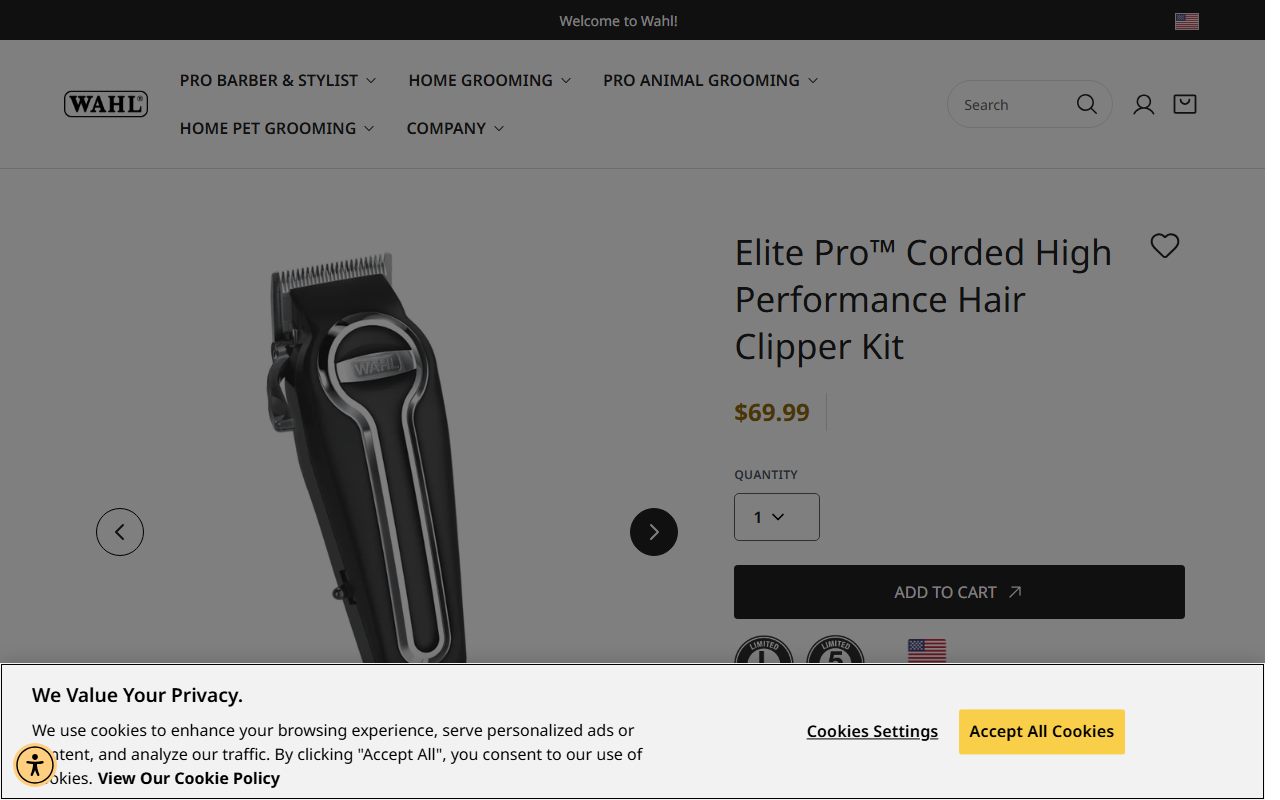
Braun's Series 7 is the AIO7440 on the US store and the MGK7440, MGK7470 or MGK7491 elsewhere, each with a different box. Wahl's Elite Pro 79602 bundle, which included a cordless trimmer, now returns a 404 on wahlusa.com; the current kit is SKU 3029684 with no trimmer. Andis's Slimline Pro Li is item 33785 in the US; the 32400 and 32475 numbers return Product Not Found.
Match the number on the page to the number on the box. Our Multigroom 9000 vs Braun Series 7 comparison has a section on exactly this trap.
Read the motor line for a number, and note when there is none
A good motor line names the type and gives a speed. Of the four sheets we read, only one does: Andis lists a rotary motor at 6,000 strokes per minute, single speed, 120 V, on the Slimline Pro Li page.
Wahl describes the Elite Pro motor as powerful and quiet and gives no speed or type. Philips and Braun print no motor speed at all; both describe a density-sensing feature instead, BeardSense on the Philips and AutoSense on the Braun.
What to conclude when the line is missing: not that the motor is weak, but that you cannot compare it. A brand that prints strokes per minute is giving you a figure you can hold it to. A brand that prints an adjective is asking for trust.
- Rotary motor: the type Andis names; common in cordless trimmers, turns a cam to move the blade.
- Magnetic or pivot motor: common in corded clippers; Wahl does not say which the Elite Pro uses.
- Strokes per minute (SPM): the one comparable number; 6,000 SPM is the only figure in this cluster.
- Density sensing: a documented feature on the Philips and Braun pages, not a measurable spec.
Read the blade line for material and maintenance
The blade line should tell you the material and whether it needs oil. Philips lists self-sharpening stainless steel and states no blade oil required. Braun lists a full-metal ProBlade it calls lifetime ultra sharp. Andis lists a carbon-steel T-blade and ships oil. Wahl lists self-sharpening blades with oil in the box and does not name the material.
Carbon steel holds a sharper edge and rusts if left wet, which is why the Andis page has no water rating and the Philips page says showerproof. Stainless steel trades a little edge for rinse-safe maintenance. Neither is better; they suit different habits.
Two lines no sheet in this cluster prints: blade width for the main trimmer head, and whether the blade is adjustable or zero-gap capable. If a retailer listing claims either, check it against the brand page before you rely on it.
Also look for a replacement blade price. Andis lists its Slimline Pro Li blade set at $22.99 on the product page. That number tells you the tool is designed to outlive its first blade, and what the second one costs.
Read runtime with the charge time next to it
Runtime alone is half a line. The useful pair is runtime plus full charge time, with a quick-charge figure as a bonus. Philips gives all three for the Multigroom 9000: up to 6 hours, a 3-hour charge and a 5-minute quick charge.
Braun gives one: up to 100 minutes for the Series 7, with no charge time on the US page. Andis gives one: up to 2 hours, no charge time. Wahl's Elite Pro is corded and has no runtime line, which is its own kind of answer.
Read the footnotes. Philips converts 6 hours to about 15 weeks of trimming by assuming two 11.6-minute trims a week, and says so in its disclaimer. That assumption is the brand's, and your trims may be longer.
Then check how it charges. Philips: USB-A cable, no adapter in the box, cordless use only. Braun: charging stand included. Andis: stand and adapter included, cord or cordless. A 100-minute battery on a stand can be more convenient than a 6-hour battery on a cable you have to find.
Count the guards by length range, not by piece count
Headline counts mix heads, guards, cases and brushes. Philips reaches 21 by counting a travel case and a brush; Braun reaches 12-in-1 by counting the trimmer body and a razor while leaving out the stand, the brush and the pouch. Both are honest on the box list and loose in the headline.
Read the length range instead. Philips: 19 settings from 0.5 to 16 mm, with 0.2 mm steps between 1 and 3 mm. Braun: 40 settings in 0.5 mm steps on a wheel, combs from 0.5 to 21 mm. Wahl: ten numbered guards from 1.5 to 25 mm plus two ear tapers. Andis: four combs from 1/16 to 3/8 inch, about 1.6 to 9.5 mm.
Now match the range to the job. Stubble under 3 mm favours the Philips steps. A locked beard length between 3 and 21 mm favours the Braun wheel. A full haircut up to a No. 8 favours the Wahl set. Necklines and edges favour the Andis T-blade, which has no long guard because it is not meant for bulk.
- Heads: separate cutting attachments; Philips lists six, Braun four, Wahl and Andis one each.
- Guards or combs: length attachments; count them and read the range in millimetres.
- Wheel: an on-body length adjuster; Braun's has 40 positions and a lock.
- Not a tool: case, pouch, brush, oil, stand, razor; useful, but not cutting capacity.
Read the warranty line, then find the conditions page
The warranty line is often the longest number on the sheet and the least complete. Philips's spec sheet reads 8-year warranty: Yes, with no conditions on the sheet. Braun badges up to 5-year warranty with terms and conditions apply and points to BraunCare+ registration. Wahl badges a limited lifetime clipper warranty and a five-year blade warranty. Andis prints 2 years.
Of the four, Wahl's is the easiest to verify: its warranty page states that it repairs or replaces free of charge within the term printed on the package, valid in the USA, by mail. Philips and Braun both defer to another page for conditions. Read that page before you count the years.
Treat a missing line as a missing line, not as a zero
The hardest discipline is not to fill gaps. Wahl prints no cord length; that does not mean the cord is short. Braun prints no charge time; that does not mean it charges slowly. Philips showed us no list price on October 16, 2026; that does not mean it is expensive.
What a missing line does tell you is how much the brand expects you to compare. A page that prints motor speed, weight, runtime and warranty on one table, as the Andis page does, is written for a buyer who reads. A page that leads with a piece count is written for a buyer who scrolls.
We grade with the same rule. Where a vendor states a figure, we print it with the date. Where it does not, the review says so, and the score reflects what was documented, not what we assume. The four reviews linked above apply this reading to each tool, and all the chairs lists every sheet we have read the same way.
Bottom line
Find the full model number first. Then read four lines: motor type and speed, blade material and maintenance, runtime with charge time, and guard range in millimetres. Note which lines are missing and do not fill them in.
Check the warranty conditions page, not just the badge. And compare box lists, not headline counts, because 21 and 12-in-1 are both counting things you cannot cut hair with. The trimmers and clippers shelf lists every sheet we have read this way, and how we grade explains the rubric.
Sources
- Philips US product data feed, MG9510/60 specification and disclaimers - checked October 16, 2026
- Braun US product page, All-in-One Series 7 Trimmer, 12-in-1 Kit, 7440 - checked October 16, 2026
- Wahl USA product page, Elite Pro Corded High Performance Hair Clipper Kit, SKU 3029684 - checked October 16, 2026
- Wahl USA warranty information page - checked October 16, 2026
- Andis product page, Slimline Pro Li T-Blade Trimmer - Black, item 33785 - checked October 16, 2026