 Five Cent
Wattage, airflow and heat: what hair dryer specs mean
Every hair dryer box prints a wattage in large type, and almost none prints the two numbers that matter more: how much air the tool moves and how hot that air gets. Wattage is the electricity the dryer draws. Airflow is the work it does with it. Heat is the risk it carries. This note explains each figure and what to look for when a vendor leaves a line blank.
The examples come from four specification pages read on October 16, 2026: the Dyson Supersonic Nural, the Dyson Airwrap Co-anda2x, the Shark FlexStyle and the Revlon One-Step Volumizer Plus. None of them was run by us; this is a reading of the sheets.
Wattage measures what the dryer draws, not what it does
A watt is a unit of electrical power. A dryer rated at 1,600 W draws up to 1,600 watts from the outlet when the motor and heater are both at maximum. On a 120 V US circuit that is about 13.3 amps, which is why Shark lists 13.33 A next to 1,600 W for the FlexStyle.
That power is split between two things: a motor that moves air and a heating element that warms it. Two 1,600 W dryers can split it differently. One can put more into the heater and blow slower, hotter air; the other can put more into the motor and blow faster, cooler air. The wattage alone cannot tell you which.
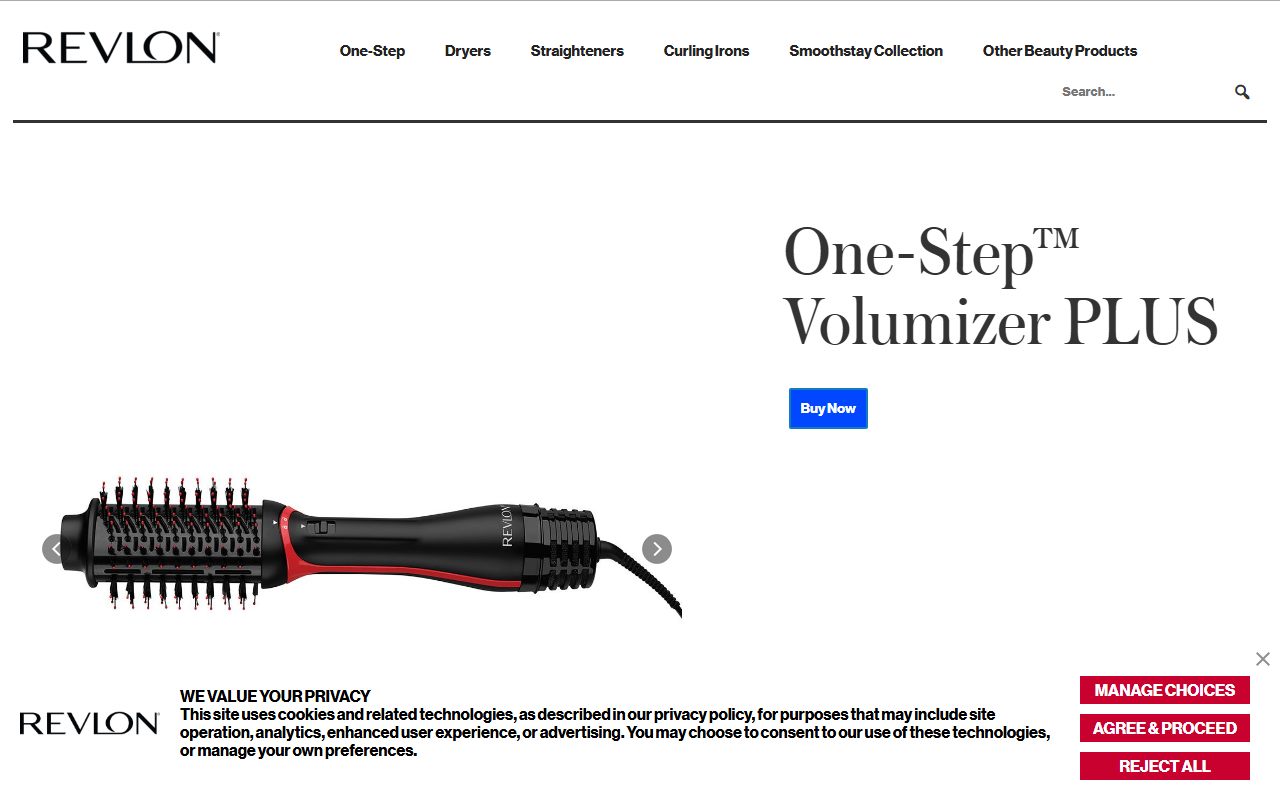
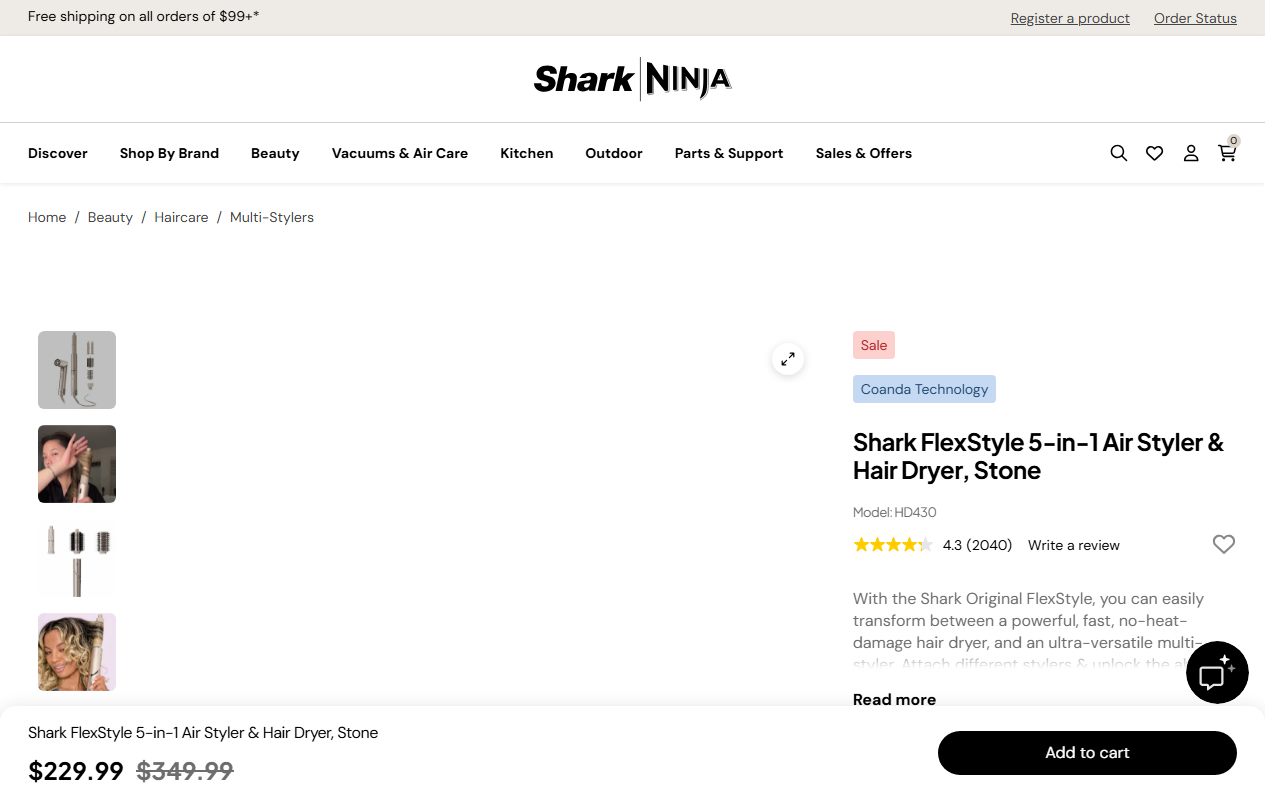
The three full dryers in our current group sit close together: the Shark FlexStyle and Dyson Supersonic Nural both list 1,600 W, and the Dyson Airwrap Co-anda2x lists 1,700 W. Revlon does not publish a wattage for the One-Step Volumizer Plus on its own page.
One practical point from the arithmetic: a 1,600 W dryer uses most of a standard 15 A household circuit. Running it on the same circuit as another heating appliance is a common way to trip a breaker. That is a wiring fact, not a dryer fault.
Airflow is the number that describes drying, and most vendors skip it
Airflow is how much air leaves the nozzle per unit of time. Dyson publishes it in litres per second: 13.3 l/s for the Supersonic Nural and 14 l/s for the Airwrap Co-anda2x. Converted by us, those are roughly 28 and 30 cubic feet per minute.
Drying is evaporation, and evaporation depends on moving air across wet hair as much as on heating it. A dryer that moves more air at a lower temperature can dry as fast as one that moves less air hotter, with less heat reaching the hair. That is the engineering argument behind every high-airflow, lower-heat dryer sold today.
Shark and Revlon publish no airflow figure. That does not mean their tools move less air; it means the buyer cannot compare. When a vendor leaves airflow blank, the wattage on the box is doing the persuading, and wattage is the weaker number.
Motor speed is a related figure that Dyson also publishes: up to 150,000 rpm and 7 kPa of pressure for the Airwrap Co-anda2x's Gen2 motor, and 110,000 rpm for the previous Airwrap i.d. High rpm from a small motor is how a slim handle produces the pressure needed for the Coanda effect that wraps hair around a barrel. It is not a drying-speed figure on its own.
Heat settings tell you about control, not about temperature
A heat settings count is the one heat figure almost every vendor publishes. The Supersonic Nural lists four heats, three speeds and a cold shot. The Airwrap Co-anda2x lists four heats and three speeds. The Revlon One-Step Volumizer Plus lists four: low, medium, high and cool. The Shark FlexStyle's US page lists none, as of October 16, 2026.
What no page in our group publishes is a temperature in degrees. Dyson says intelligent heat control monitors air temperature to prevent excessive heat damage; Shark says the FlexStyle measures and regulates temperature 1,000 times per second; Revlon claims 50% less heat exposure. None gives a maximum or a target.
So the settings count is a control figure: more settings mean finer choice between fast and gentle. It is not a safety figure, because the same label, high, can mean different temperatures on different tools. A cold shot button is worth looking for because it is the one setting whose temperature you do know: room air.
Why distance and movement matter more than the setting
The best published evidence on dryer heat and hair is a 2011 study in Annals of Dermatology by Lee and colleagues, which dried hair samples 30 times under five conditions and examined the surface. The conditions were air drying at 20 degrees C, a dryer at 15 cm for 60 seconds at 47 degrees C, at 10 cm for 30 seconds at 61 degrees C, and at 5 cm for 15 seconds at 95 degrees C.
Surface damage rose with temperature, while the inner cortex was not damaged in any group. The authors' conclusion, quoted from the abstract, is that using a hair dryer at a distance of 15 cm with continuous motion causes less damage than drying hair naturally, because prolonged wetness also damages the cuticle.
That study is why features that manage distance are more than marketing. The Supersonic Nural's Scalp protect mode uses a time-of-flight sensor to lower air temperature as the dryer gets closer to the head, which addresses exactly the variable the study found most important. Whether it works as described is a claim we cannot test, but the logic is sound.
- Distance: the study's 15 cm condition produced far less surface damage than 5 cm. Hold the nozzle away and keep it moving.
- Movement: continuous motion spreads heat; a dryer held still on one section concentrates it.
- Time wet: the study found natural drying also damaged the cuticle, so faster drying at moderate heat is not the worse option.
- Settings: the lowest setting that dries in a reasonable time is the sensible default; the cold shot sets a style without adding heat.
Weight and cable length are the comfort figures, and one vendor muddles them
Weight is published by Dyson for both tools: 1.8 lb for the Supersonic Nural and 0.9 lb for the Airwrap Co-anda2x body, without attachments. Shark lists 3.72 lbs in the FlexStyle's details table and just over 1.5 lbs in its feature copy; the larger figure sits beside boxed dimensions, so it is probably a shipping weight, but Shark does not label it. Revlon lists nothing.
A dryer is held at or above shoulder height for several minutes, and a hot-air brush for longer. Half a pound is noticeable. When a vendor publishes two weights, ask which one is the tool; when a vendor publishes none, the box or the manual is your only source.
Cable length is simpler. The Supersonic Nural lists 8.6 ft, the FlexStyle 8 ft and the Airwrap Co-anda2x 6.55 ft. Anything under 7 ft can be short for a bathroom where the outlet is beside the sink and the mirror is across the room.
The plug is a safety spec, and in the US it is mandatory
US hair dryers carry a large rectangular plug with Test and Reset buttons. That is an immersion protection device, usually an appliance leakage current interrupter, and it cuts power if the dryer falls into water. The US Consumer Product Safety Commission has determined that hand-supported hair dryers without integral immersion protection are a substantial product hazard, listed at 16 CFR 1120.3 with reference to UL 859.
This matters when buying from marketplaces where imported dryers appear without the block plug. A dryer sold for the US market should have it; one that does not should not be in a US bathroom. The vendors in our group all sell UL-listed tools through their own US sites.
Voltage is the related travel figure. All four tools we read are specified at 120 V, and Revlon's FAQ states that using a voltage converter on a non-dual-voltage appliance is not recommended. A 1,600 W heating appliance is a poor candidate for a travel converter regardless of brand.
How to read a dryer spec sheet in two minutes
- Find the wattage and move on. 1,600 to 1,875 W is normal for a full-size US dryer. It tells you the circuit load, not the drying speed.
- Look for airflow. If a vendor publishes litres per second or cubic feet per minute, it is confident in its motor. If not, the wattage is doing the selling.
- Count the heat and speed settings, and check for a cold shot. This is the control you will actually use. No published count is a documentation gap worth noting, as with the FlexStyle.
- Check the weight, and check that it is the tool's weight, not the box's.
- Check the cable. 8 ft or more is comfortable; under 7 ft can be limiting.
- Confirm the plug. A US dryer has the block plug with Test and Reset. If the listing photo does not show it, ask.
- Read what is in the box. A diffuser or a straightener that is not included is a $39.99 line item, not a free feature.
Bottom line
Wattage is the easiest number to print and the least useful to compare. Airflow describes drying and is the number vendors most often omit. Heat settings describe control, not temperature, and no vendor in our group publishes a temperature. Distance and movement, per the one controlled study we can cite, matter more than the setting label.
When a sheet is incomplete, say so rather than guess. That is how we graded this group in the best hair dryers and multi-stylers, and it is why the fully documented Dyson Supersonic Nural scores so well on features while the better-value Shark FlexStyle tops the ranking anyway. For a head-to-head on those two, read Dyson Supersonic Nural vs Shark FlexStyle; for the simplest tool of the four, the Revlon One-Step Volumizer Plus review.
Sources
- Lee Y, Kim YD, Hyun HJ, Pi LQ, Jin X, Lee WS. Hair shaft damage from heat and drying time of hair dryer. Annals of Dermatology. 2011;23(4):455-462. doi:10.5021/ad.2011.23.4.455 - checked October 16, 2026
- US Consumer Product Safety Commission, Hand-Supported Hair Dryers business guidance (16 CFR 1120.3, UL 859) - checked October 16, 2026
- Dyson Supersonic Nural specification table - checked October 16, 2026
- Dyson Airwrap Co-anda2x specification table - checked October 16, 2026
- Shark FlexStyle HD430 product page - checked October 16, 2026
- Revlon One-Step Volumizer PLUS product page and Revlon FAQs - checked October 16, 2026