 Five Cent
The best safety razors for a first wet shave
Short answer: the best safety razor for a first wet shave is the Henson AL13, because its maker fixes the blade at 30 degrees, publishes a mild 0.033 mm exposure, ships five blades and backs it with a 100-day return and a lifetime defect warranty for $89.00. The best value is the Rockwell 6C at $60.00, whose three reversible plates give six published blade gaps, so it grows with the shaver. This guide grades five razors from Henson, Rockwell, Leaf, Merkur and DOVO using product pages, FAQs, warranty terms and return policies checked October 17, 2026. We did not shave with any of them. How we picked is explained below the list.
Our picks
- Best overall for a first wet shave: Henson AL13
- Best value and best adjustable: Rockwell 6C
- Best for switching from cartridges: Leaf Two Razor
- Best heavy classic for the money: Merkur 34C HD
- Best Solingen closed comb with published geometry: DOVO Primo I
The best safety razors for a first wet shave at a glance
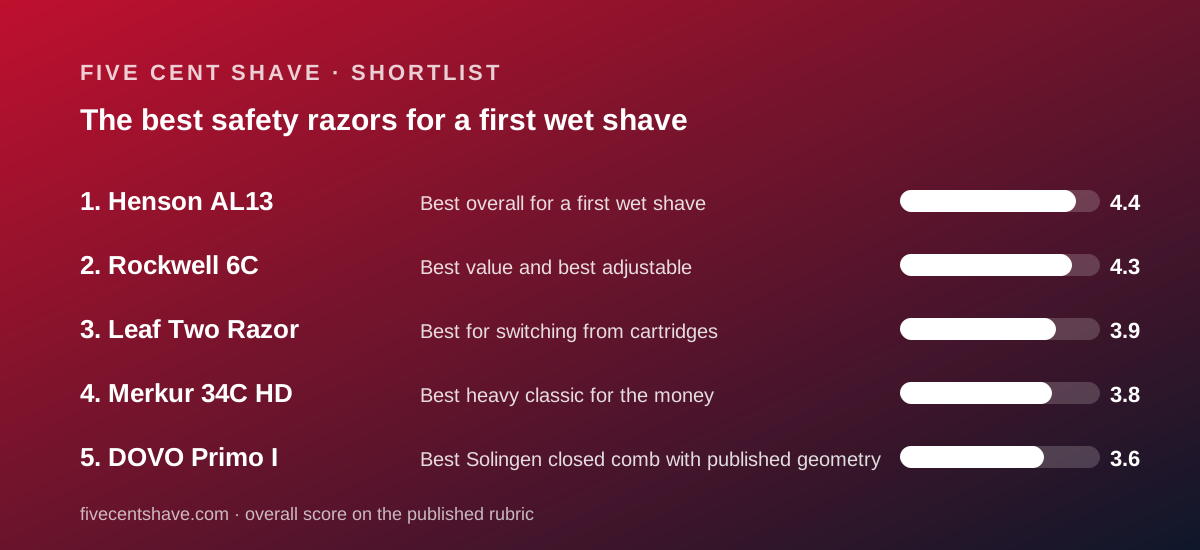
Five razors from five makers and a price spread from $55.00 to $109.00. The quickest way to choose is to decide what worries you most about switching: the angle, the cost, the learning curve, or the feel of a traditional heavy razor.
- Henson AL13 - best overall: fixed 30 degree angle, 0.033 mm exposure, five blades, 100-day return, lifetime defect warranty, $89.00
- Rockwell 6C - best value and best adjustable: six published gaps from 0.20 to 0.79 mm, 100-day return with prepaid label, $60.00
- Leaf Two Razor - best for cartridge switchers: pivoting head, one or two half blades, 139 g, $109.00
- Merkur 34C - best heavy classic for the money: 78 g brass and chrome, two-piece head, about $55.00 at a US retailer
- DOVO Primo I - best Solingen closed comb with published geometry: 0.6 to 0.65 mm gap, $60.00
The two most-searched beginner razors, the Henson AL13 and the Merkur 34C, are compared head to head in Merkur 34C vs Henson AL13. The short version: the Henson wins on published geometry and support, the Merkur on weight and price.
How the five compare on paper
All figures below were read on the makers' own pages on October 17, 2026, except the Merkur's US price, which comes from one US retailer because Merkur's shop does not ship to the US. Overall scores are the average of our four pillars.
- Henson AL13: 4.38 overall. Fixed angle, 0.68 mm gap, 0.033 mm exposure, 37 g, aluminum, Canada, five blades, 100 days, lifetime defects, $89.00.
- Rockwell 6C: 4.33 overall. Six plates, 0.20 to 0.79 mm gap, over 100 g, chromed zinc, 100 days with prepaid label, $60.00.
- Leaf Two Razor: 3.85 overall. Pivoting head, gap not published, 139 g, ten half blades, 30 days, one-year warranty, $109.00.
- Merkur 34C: 3.78 overall. Two-piece closed comb, gap not published, 78 g, brass and zinc, Germany, 14-day withdrawal, two-year EU statutory warranty, $55.00 at a US retailer.
- DOVO Primo I: 3.60 overall. Three-piece closed comb, 0.6 to 0.65 mm gap, weight not published, brass and zinc, Germany, one blade, 14-day withdrawal, $60.00.
What makes a safety razor beginner-friendly on the spec sheet
Four numbers and one design choice do most of the work. None of them needs a lab to read; they are on the maker's page or they are not, and a missing figure is itself information.
Blade exposure is how far the edge stands proud of the line from guard to cap. Smaller is milder. Henson prints 0.033 mm for the AL13 and DOVO prints 0.06 to 0.07 mm for the Primo I; Rockwell, Merkur and Leaf do not print exposure for these models.
Blade gap is the space between the blade edge and the guard. A larger gap lets more lather and hair through; in both Henson's and Rockwell's published ladders, the larger gaps are the more aggressive settings. Rockwell's six plates span 0.20 to 0.79 mm; Henson states 0.68 mm; DOVO states 0.6 to 0.65 mm. Merkur calls the 34C's gap generous without a number.
Blade angle is the angle the shaver must hold for the edge to meet the skin. Henson is the only maker here that fixes and states it, at 30 degrees. Leaf solves the same problem differently, with a pivoting head that finds the angle against the face.
Weight changes how much pressure the shaver adds. Merkur states the 34C's weight gives more grip and a smooth shave, and Rockwell stresses that the 6C is about three times the weight of a cartridge or aluminum razor. Henson argues the opposite, that rigid blade support matters more than mass. Neither side publishes a study, so treat weight as preference.
A closed comb is the guard Merkur's own explainer calls the standard type for daily shaving. Four of the five razors in this guide are closed combs; the Leaf uses its own pivoting head, and none is an open comb or slant.
Returns and warranty matter more for a first razor
A first razor is a guess, so the return window is worth more than it would be on a fifth. On October 17, 2026, Henson and Rockwell both stated 100-day returns; Rockwell includes a prepaid label, while Henson's buyer pays postage. Leaf states 30 days with the buyer paying postage.
The two Solingen razors follow European terms. Merkur's own shop and DOVO's terms describe a 14-day withdrawal right and statutory defect warranty. Merkur does not ship to the US from its own shop, so a US buyer of the 34C is covered by the retailer's terms instead.
On warranty, Henson states lifetime coverage for manufacturing defects, Leaf states one year, Rockwell's lifetime wording names the 6S rather than the 6C, and the two German makers give statutory coverage of at least two years under EU law.
What is in the box, and what to add to the first order
A razor alone is not a shave. Before checking out, compare what each listing includes, because the cheapest razor is not always the cheapest first order. All contents below are as stated on the makers' pages on October 17, 2026.
- Henson AL13, $89.00: razor and five RK stainless blades. The machined aluminum stand and leather head covers are sold separately; free US shipping starts at $125.
- Rockwell 6C, $60.00: razor with three reversible plates; blade count not stated on the single-razor listing. The 2-Year Kit adds a stand and 100 blades for $105.00, down from $118.00.
- Leaf Two Razor, $109.00: razor and ten single-edge blades. The Kit at $149.00 and the Bundle at $199.00 add a 50-count blade pack and accessories.
- Merkur 34C, about $55.00 at a US retailer: razor in a folding carton; Merkur's page states no blade count. Merkur's own 4002 stand is 60.00 euros.
- DOVO Primo I, $60.00: razor, one DOVO Super Platinum blade and an embossed box; no stand.
For a first order, the practical rule is to add a pack of double-edge blades to any razor that ships with fewer than five. Rockwell's kit is the only bundle here that includes both a stand and a two-year blade supply at a stated discount.
Materials, finish and where each razor is made
Material decides weight and finish, and it is one of the few things every maker here documents at least in part.
- Henson AL13: 6061-T651 aluminum with a Type II anodize finish Henson states will not peel or flake; made in Ontario, Canada to AS9100 standards.
- Rockwell 6C: chromed zinc alloy Rockwell states is nickel-free; country of manufacture not stated, orders ship from New York.
- Leaf Two Razor: all metal, per Leaf; the alloy, plating and country of manufacture are not named on the page.
- Merkur 34C: brass handle and die-cast zinc head, electroplated in bright chrome; designed and made in Solingen, Germany.
- DOVO Primo I: brass handle and zinc die-cast head, electroplated in bright chrome; made in Solingen, Germany.
Shoppers with a known metal sensitivity should note that only Rockwell makes a nickel-free statement for its razor among these five. That is a maker claim, not medical advice; anyone with a diagnosed allergy should ask the maker and a clinician before buying.
Owner data: what each page shows
Owner evidence for safety razors is thin and mostly vendor-hosted. On October 17, 2026, the Henson AL13 page carried 4.69 out of 5 from 20,657 ratings in its structured data, the Rockwell 6C page showed 2,554 reviews with about 80 percent at the top rating, and the Leaf Two page showed 444 reviews.
The Merkur 34C page on the maker's shop showed zero reviews, and DOVO's US store page for the Primo I showed no ratings. We found no independent, verified-purchase dataset for any of the five that we could read directly and date, so owner ratings do not move the scores in this guide.
Blades and running cost are close to a tie
Every razor here takes standard double-edge blades, whole or, in the Leaf's case, snapped in half. That means the cost per shave is set by the blade the owner chooses, not the razor. Merkur, for example, lists its Super Platinum 100-pack at 59.00 euros, which is 0.59 euros a blade by our arithmetic.
What differs is the starting supply. Henson ships five blades, Leaf ten half blades, DOVO one, and Rockwell's and Merkur's single-razor listings do not state a count. Add a pack of blades to the first order unless the listing confirms what is in the box.
Loading a blade and caring for the razor
Blade changes are where the designs differ most in daily use, and the makers document them unevenly.
- Three-piece (Henson AL13, DOVO Primo I): the handle unscrews, the cap and baseplate separate, and the blade sits between them. Henson shows an assembly image in its FAQ; DOVO describes a stabilized screw.
- Two-piece (Merkur 34C): a knob at the base of the handle opens the cap on its neck, so no plate comes loose, per Merkur's own explainer.
- Plate swap (Rockwell 6C): the head unscrews, and the chosen plate is flipped or swapped to change the gap.
- Half blades (Leaf Two Razor): a double-edge blade is snapped in half and one or two halves are loaded into the pivoting head.
Only Henson writes a care routine on its pages: rinse after each shave, loosen the handle about one and a half turns so the blade is not stored under tension, store the razor on its side in a dry place, and clean it with soap, water and a soft toothbrush. Henson states the AL13 is not dishwasher safe.
Merkur's 34C product page, read October 17, 2026, gave no care steps; for the Rockwell, Leaf and DOVO razors, check the maker's FAQ before the first clean.
Safety razor or electric shaver?
A safety razor is the cheapest way to shave well over years, but it is not the easiest way to shave in a hurry. If speed, travel charging or a dry shave matters more than cost per shave, read our best electric shavers guide and the foil versus rotary explainer first.
The least expensive electric in that guide is $199.96, and the Braun Series 7 with a cleaning station is $199.99, more than any razor here. Electric shavers also carry head replacement costs that a razor does not.
If you keep a beard and only tidy the edges, neither is the main tool; our best beard trimmers and hair clippers guide covers that job, with the Philips Norelco Multigroom 9000 as the all-in-one pick.
Who should buy which
- You want the lowest-risk first razor: Henson AL13.
- You want to start mild and open up later without buying again: Rockwell 6C.
- You are switching from cartridges and fear holding the angle: Leaf Two Razor.
- You want the traditional heavy brass razor and the lowest price: Merkur 34C.
- You want a Solingen closed comb whose maker prints the gap and exposure: DOVO Primo I.
What this guide does not claim
This is a documentation guide. We did not shave with these razors, and we do not rank them on smoothness, closeness or irritation, because none of the makers publishes independent data on those outcomes. Henson's page cites a 77 percent razor-burn reduction against multi-blade razors without linking the study, and we report it as the vendor's claim.
Every price and specification was read on the maker's page on October 17, 2026, and will change. Each linked review lists its sources with the date they were checked.
Also compared
Henson Ti22. Henson Ti22, the titanium version of the Henson design, sold in medium and aggressive settings per Henson's FAQ checked October 17, 2026. Henson lists it as final sale, so it loses the 100-day return that makes the AL13 the safer first purchase.
Merkur 34 ADJ. Merkur 34 ADJ, an adjustable version of the 34 body with a stated 0.6 to 1.6 mm gap range, 75.00 euros on merkur-razors.com on October 17, 2026. Not sold to the US by the maker, and the Rockwell 6C covers adjustability for $60.00 with a 100-day return.
Rockwell 6S. Rockwell 6S, the stainless steel sibling of the 6C, is the model Rockwell's lifetime warranty wording names. It costs more than the 6C, and a first-time buyer gets the same six-plate idea from the 6C for $60.00.
Best overall for a first wet shave: Henson AL13
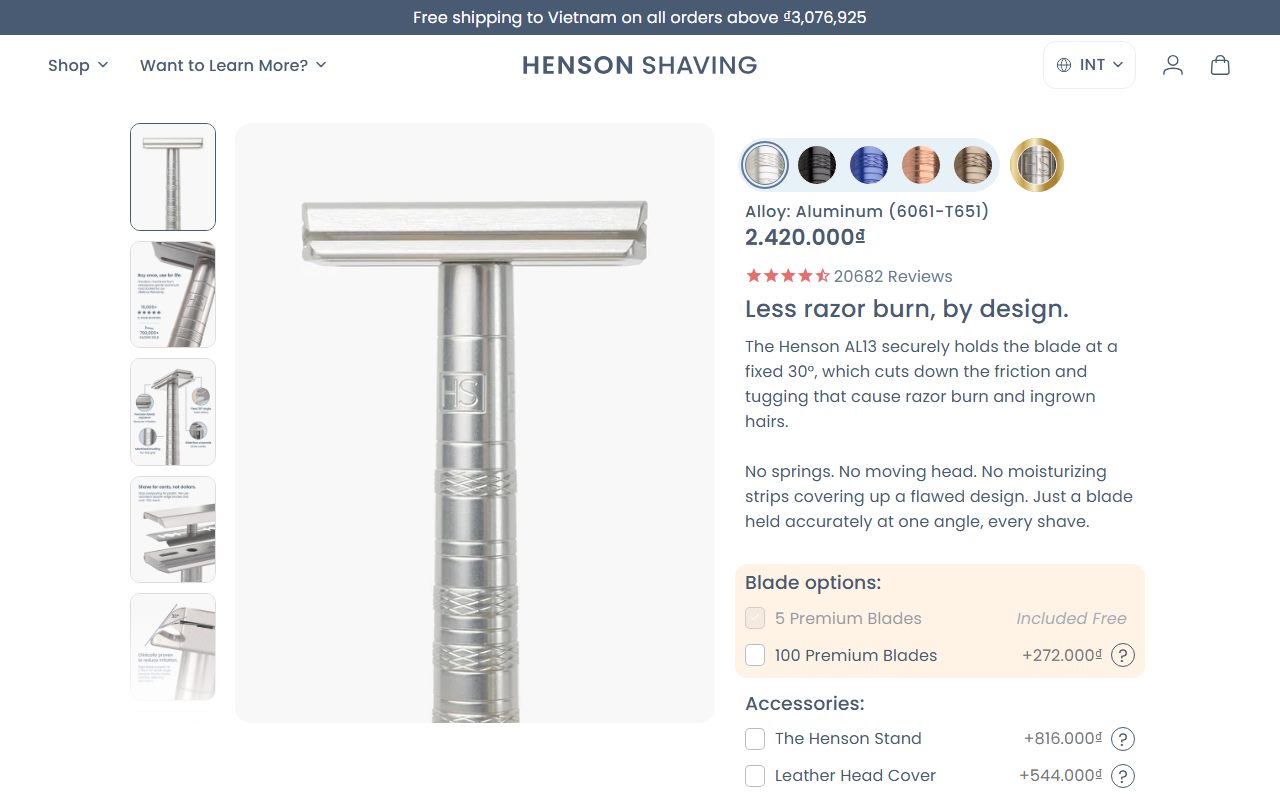
The Henson AL13 clamps a standard double-edge blade at a fixed 30 degree angle with a 0.68 mm gap and 0.033 mm exposure, the mildest published geometry in this guide, per Henson's FAQ checked October 17, 2026. It weighs 37 g, is machined from 6061-T651 aluminum in Ontario, Canada to AS9100 standards, and ships with five RK stainless blades for $89.00. Henson gives 100 days to return it, with the buyer paying postage, and a lifetime warranty on manufacturing defects. The limits: aluminum comes in one mild aggression only, there is no stand in the box, and the light weight will not suit someone who wants heft.
It sits at number one because it removes the beginner's main variable, the angle, and pairs that with the strongest return and warranty terms on this list; it would drop only for a buyer who wants weight or adjustability.
Visit Henson AL13
We have no affiliate relationship with this vendor. Link goes to the official site.
Best value and best adjustable: Rockwell 6C
The Rockwell 6C ships with three reversible base plates that give six published gaps, from R1 at 0.20 mm to R6 at 0.79 mm, per Rockwell's FAQ checked October 17, 2026. That lets one $60.00 razor start mild and open up as technique improves. The body is a chromed zinc alloy Rockwell states is nickel-free, weighing over 100 g by the maker's own description. Returns are 100 days with a prepaid label, and Rockwell replaces items that arrive defective. The limits: the lifetime warranty wording names only the stainless 6S, the exact weight and country of manufacture are not printed, and changing aggression means opening the head and swapping a plate.
It sits at number two, a few hundredths behind the Henson, because adjustability and price beat the Henson on value while the fixed angle and lifetime defect warranty keep the Henson ahead for a true first shave.
Visit Rockwell 6C
We have no affiliate relationship with this vendor. Link goes to the official site.
Best for switching from cartridges: Leaf Two Razor
The Leaf Two Razor is the only pivoting head in this guide, which makes it the closest to a cartridge in how it follows the face. It loads one or two half double-edge blades, weighs 139 g per Leaf's product data, and ships with ten single-edge blades for $109.00 in Prism, Chrome or Black, checked October 17, 2026. Leaf gives a one-year limited warranty and a 30-day return with the buyer paying postage. The limits: it is the most expensive razor here, its blade gap and exposure are not published, and the page names no alloy or country of manufacture.
It sits at number three because the pivot answers the most common fear about safety razors, holding the angle, but its price and short terms keep it below the two razors above.
Visit Leaf Two Razor
We have no affiliate relationship with this vendor. Link goes to the official site.
Best heavy classic for the money: Merkur 34C HD
The Merkur 34C, long nicknamed HD for Heavy Duty, is a two-piece closed comb with a brass handle and a die-cast zinc head in bright chrome, 78 g in an 81 x 43 x 25 mm body, made in Solingen, per Merkur's product page checked October 17, 2026. It costs 52.00 euros from the maker and was listed at $55.00 by a US retailer the same day, the lowest price here. The two-piece head opens with a turn of the knob, and Merkur sells a spare cap. The limits: no published gap, exposure or angle, no stated blade count in the box, and the maker's shop does not ship to the US.
It sits at number four because its build and price are strong but its maker documents no geometry and its US buyers rely on retailer terms rather than a maker trial.
Visit Merkur 34C HD
We have no affiliate relationship with this vendor. Link goes to the official site.
Best Solingen closed comb with published geometry: DOVO Primo I
The DOVO Primo I is a three-piece closed comb with a brass handle and a zinc die-cast head under bright chrome, made in Solingen, and its maker prints both a 0.6 to 0.65 mm gap and a 0.06 to 0.07 mm exposure, per DOVO's US store checked October 17, 2026. It costs $60.00 with one DOVO Super Platinum blade and measures 4.1 by 2.5 by 10.6 cm. The terms describe a 14-day withdrawal right and statutory defect liability under German law. The limits: DOVO does not print the weight, there is no stand or owner rating on the page, and the return terms are short for a first razor.
It sits at number five because its published geometry is a real strength but its support terms and thin box are the weakest on this list for a beginner.
Visit DOVO Primo I
We have no affiliate relationship with this vendor. Link goes to the official site.
How we chose
We did not run tests of our own; grades come from maker documentation, pricing pages, warranty and return terms, and owner data where the maker's page shows it, all checked on October 17, 2026. Each razor is scored out of 5 on four pillars, weighted equally, and the overall figure is their average.
Ease rewards what a beginner cannot get wrong: a closed comb, a fixed or published angle, mild published exposure, simple blade loading and written care steps.
Features counts what the maker documents: blade gap, exposure and angle in millimetres or degrees, weight, materials, finishes, adjustability and spare parts. A figure the maker does not print scores nothing, however well regarded the razor is.
Value compares the list price with what ships in the box (blades, stand, case) and with the rest of this list. Running cost is the same for any razor that takes standard double-edge blades.
Support reads the return window, who pays return postage, the warranty term and whether the maker ships to the US. A long, documented trial matters more for a first razor than for a fifth.
Frequently asked
What is the best safety razor for a beginner?
On the documentation, the Henson AL13. It fixes the blade at 30 degrees with a published 0.033 mm exposure, includes five blades, and offers a 100-day return and a lifetime defect warranty for $89.00, per Henson's pages checked October 17, 2026.
What is the cheapest good safety razor for a first shave?
The Merkur 34C at $55.00 through a US retailer, or the Rockwell 6C at $60.00 from the maker. The Rockwell adds six published gap settings and a 100-day return with a prepaid label, which is why it ranks higher in this guide.
Is a heavy safety razor better for beginners?
Makers disagree. Merkur states the 34C's weight gives grip and a smooth shave, and Rockwell stresses the 6C's weight; Henson argues that rigid blade support and a fixed angle matter more and makes the AL13 37 g. No maker publishes independent data, so treat weight as a preference.
Should a beginner buy an adjustable safety razor?
An adjustable razor such as the Rockwell 6C lets a beginner start at the mildest setting, 0.20 mm gap on its R1 plate, and open up later. The trade-off is swapping plates. A fixed mild razor like the Henson AL13 removes that choice entirely.
Do all safety razors use the same blades?
All five razors here take standard double-edge blades. The Leaf Two Razor uses them snapped in half, one or two at a time. Blade choice, not the razor, sets the running cost, and any brand's double-edge blades fit the other four.
Is a safety razor cheaper than an electric shaver?
Up front, yes: the razors here cost $55.00 to $109.00, while the least expensive shaver in our electric shaver guide is $199.96. Over time a razor's only consumable is blades, while electric shavers need replacement heads on a maker-stated schedule.
Sources
- Henson Shaving AL13 product page, FAQ and refund policy - checked October 17, 2026
- Rockwell Razors 6C product page and FAQ - checked October 17, 2026
- Leaf Shave Leaf Two Razor product page - checked October 17, 2026
- MERKUR 34C product page - checked October 17, 2026
- DOVO US store, Safety Razor Primo I - checked October 17, 2026