 Five Cent

Philips Sonicare 9900 Prestige
Philips' top sonic brush with SenseIQ sensing, five modes, three intensities, a stated 14-day battery and a USB charging travel case
Scored on the published rubric, from documentation, pricing and verified user reports.
Best for: People who want a sonic brush that adapts intensity to pressure automatically, a published two-week battery, and a USB charging case, and who accept a $400 class price.
Verdict
The Philips Sonicare 9900 Prestige (HX9990/12) is the best-documented premium brush in this documentation review, and that is its strongest argument. Philips publishes what Oral-B does not: 62,000 brush movements per minute, a 14-day operating time from full to empty, a 110 to 220 V power supply, the exact box contents and a two-year software update commitment, all read from the US product page on October 16, 2026. SenseIQ checks pressure, motion and coverage up to 100 times per second and automatically lowers intensity when you press too hard, which is a step beyond a warning light. The price is the problem: $399.96 in the page's product data, with one A3 Premium All-in-One head in the box, against $249.99 for the Oral-B iO Series 9 with four heads. Verified buyers on the Philips page praise the app and battery and name price as the recurring con. If you want a sonic brush and the documentation to back it, this is it. If you want value, it is not.
Visit Philips Sonicare 9900 Prestige
We have no affiliate relationship with this vendor. Link goes to the official site.
Where it is strong
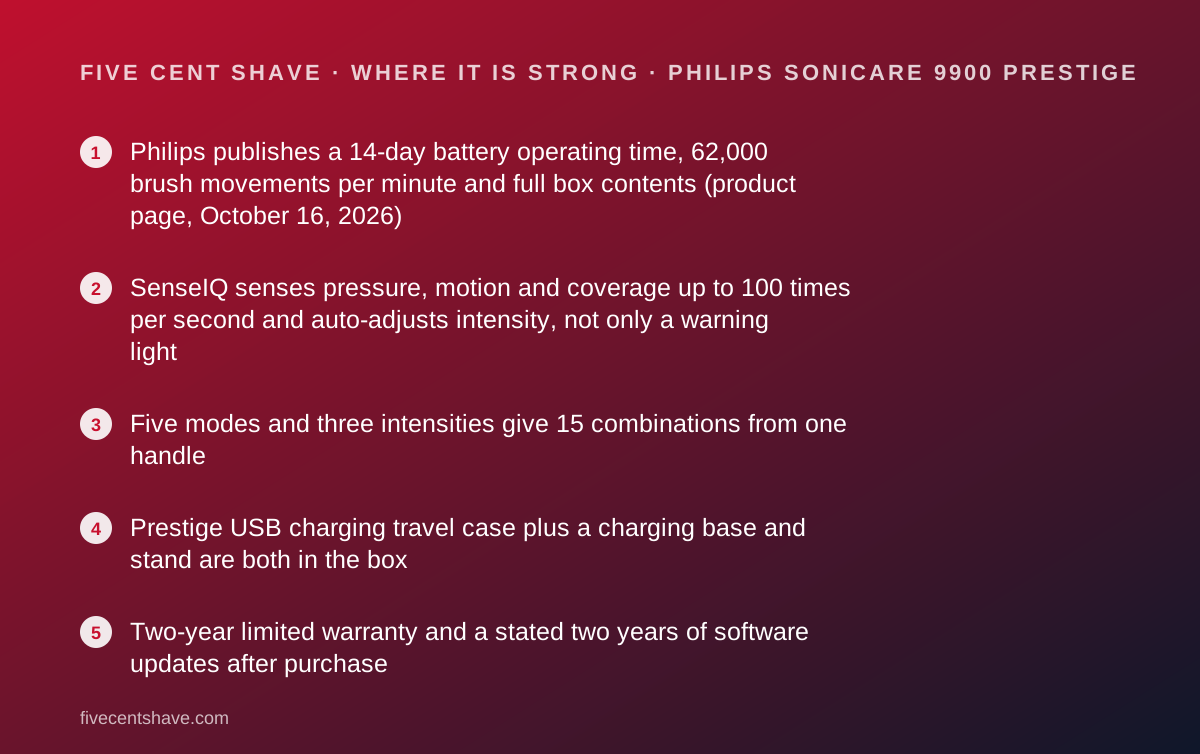
- Philips publishes a 14-day battery operating time, 62,000 brush movements per minute and full box contents (product page, October 16, 2026)
- SenseIQ senses pressure, motion and coverage up to 100 times per second and auto-adjusts intensity, not only a warning light
- Five modes and three intensities give 15 combinations from one handle
- Prestige USB charging travel case plus a charging base and stand are both in the box
- Two-year limited warranty and a stated two years of software updates after purchase
- BrushSync head replacement reminder and a 110 to 220 V power supply for travel
Where it falls short
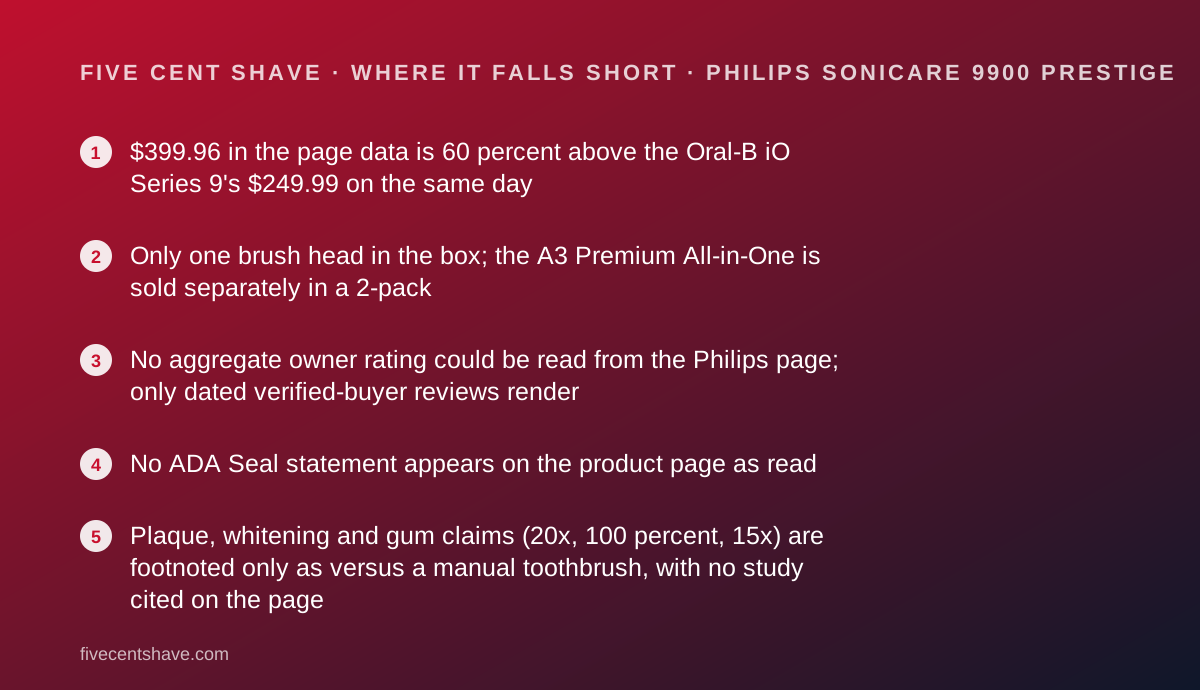
- $399.96 in the page data is 60 percent above the Oral-B iO Series 9's $249.99 on the same day
- Only one brush head in the box; the A3 Premium All-in-One is sold separately in a 2-pack
- No aggregate owner rating could be read from the Philips page; only dated verified-buyer reviews render
- No ADA Seal statement appears on the product page as read
- Plaque, whitening and gum claims (20x, 100 percent, 15x) are footnoted only as versus a manual toothbrush, with no study cited on the page
At a glance
| Brushing technology | Sonic (Sonicare Fluid Action), 62,000 brush movements per minute |
|---|---|
| Sensing | SenseIQ: pressure, motion and coverage up to 100 times per second; auto-adjusts intensity |
| Pressure feedback | Ring lights up purple, vibration and pulsing sound |
| Modes and intensities | 5 modes (Clean, White+, Deep Clean, Gum Health, Sensitive); 3 intensities (Low, Medium, High) |
| Battery | Lithium-ion, 14 days operating time full to empty; illuminated battery icon |
| Charging | Charging base and stand plus Prestige USB charging travel case; 110 to 220 V |
| App | Sonicare app over Bluetooth 4.0+: real-time coaching, progress reports, BrushPacer, SmartTimer, BrushSync |
| In the box | 1 handle, 1 A3 Premium All-in-One head, 1 USB charging travel case, 1 charging base and stand |
| Software support | Relevant software updates for 2 years after purchase |
| Warranty | 2-year limited warranty |
| Price | $399.96 per the product page data, October 16, 2026 |
| Pricing note | $399.96 in the usa.philips.com product data for HX9990/12 (in stock), one A3 Premium All-in-One head, USB charging travel case and charging base in the box, checked October 16, 2026 |
What the Sonicare 9900 Prestige actually is
The 9900 Prestige is the top of Philips' Sonicare range on the US site. Philips files it under the DiamondClean family in the box contents, and the model number is HX9990/12 (Champagne), with Midnight Blue and Pink variants.
It is a sonic brush: the head sweeps side to side at 62,000 brush movements per minute, per the specification data on the product page. That is a different motion from the oscillating round head on the Oral-B iO Series 9, and the ADA does not rank one motion above the other.
What Philips sells here is sensing. SenseIQ measures pressure, motion and coverage up to 100 times per second and adjusts intensity on its own. The rest of the package is premium trim: a USB charging case, a two-year software commitment and a single high-end head.
All figures were read from the US product page on October 16, 2026. The visible page truncates its specification table, so this review also read the page's embedded specification data. How we grade explains the method.
Who the 9900 Prestige is best for
The spec sheet points to a buyer who values sensing and documentation over price.
- People who brush too hard and want the brush to back off automatically rather than flash a light
- People who want a published battery figure to plan around: 14 days, per Philips
- Travelers: USB charging case and 110 to 220 V supply are both stated
- People who want fine control: 5 modes times 3 intensities
- Owners of other Sonicare handles who already have click-on heads and the app
- Buyers who want a vendor that states its software support period: two years after purchase
Who should skip it
The documents argue against it for three groups.
- Value buyers: the Oral-B iO Series 5 covers pressure sensing, a timer and app tracking at a quarter of the price
- People who want the ADA Seal displayed on the product page: Philips does not show one here
- People who want multiple heads in the box: one A3 head is included
SenseIQ and the pressure feedback, per the spec sheet
Philips lists SenseIQ as sensing pressure, motion and coverage up to 100 times per second while you brush. The specification entry under Pressure feedback reads: automatically adjusts brushing based on pressure and motion. The feedback itself is a ring that lights up purple plus vibration and a pulsing sound.
That is the key difference from Oral-B's Smart Pressure Sensor, which signals too hard, too soft or just right but leaves the correction to you. Philips reduces intensity for you.
The ADA recommends soft bristles to reduce gingival abrasion, and the A3 head is listed as soft. An adaptive motor plus soft bristles addresses overbrushing from both ends. Philips does not publish a clinical study on the page for the adaptive feature itself.
Coverage sensing feeds the app's missed-area feedback. Philips does not publish an accuracy figure for coverage detection.
Modes, intensities and the A3 head
Five modes are listed in the specification data: Clean for an everyday clean, White+ to help remove surface stains, Deep Clean for an invigorating deep clean, Gum Health to gently massage gums, and Sensitive for sensitive teeth and gums. Three intensities, Low, Medium and High, apply across them.
The A3 Premium All-in-One head (HX9092/95 for refills) is marketed as Philips' best cleaning head. The page claims it removes up to 20 times more plaque, gives 100 percent whiter teeth in two days and up to 15 times healthier gums in six weeks. Every one of those claims is footnoted as versus a manual toothbrush, with no study cited on the page.
The head is soft-bristled and listed as 70 percent bio-based plastic. BrushSync tracks head wear and reminds you to replace it; the ADA's interval is every three to four months or when bristles fray.
Only one head ships in the box. Budget for a 2-pack early.
Battery, charging and the travel case
This is where Philips' documentation earns its score. The specification data states a lithium-ion battery, an operating time of 14 days from full to empty, an illuminated icon that indicates battery life, and a 110 to 220 V power supply.
For comparison, neither Oral-B iO page publishes a runtime. The iO9 states about three hours to full charge; Philips does not state a charge time on this page, so each vendor leaves one gap.
The box contains a charging base and stand for the counter and a Prestige USB charging travel case. The case charges the handle over USB, so a laptop or phone charger covers travel. Oral-B's Power2Go case on the iO9 does the same job with its own cord.
Verified buyers on the page repeatedly mention that the handle holds its charge, including one review dated after four years of use. That is owner report, not vendor spec, and it is noted as such.
The app and the software commitment
The Sonicare app connects over Bluetooth 4.0 and above on iPhone and Android, per the compatibility rows. Listed functions: real-time coaching with SenseIQ (instant feedback on pressure, motion and coverage), personalized guidance (customized tips from your patterns), tracking and progress reports, BrushPacer and SmartTimer, and BrushSync replacement reminders.
The support page's FAQ titles add Scrubbing Feedback, Adaptive Intensity and Apple Health sync; the answers themselves did not render, so this review lists the titles only.
One line matters more than the feature list: Philips offers relevant software updates for a period of two years after the date of purchase. Oral-B publishes no equivalent statement on the iO pages. For a $400 connected device, a stated support window is worth having in writing.
The handle works without the app: modes, intensities, timer and pressure feedback are all on the handle.
How the price is structured (as of October 2026)
The usa.philips.com page did not display a price in its readable text on October 16, 2026. The page's embedded product data listed $399.96 for HX9990/12 with an in-stock status, and a discount-price field whose value could not be read. This review quotes $399.96 and flags how it was obtained.
Refills are the second cost. The A3 Premium All-in-One is sold as a 2-pack (HX9092/95); the refill price was not read on the product page. At the ADA's three-to-four-month interval, one 2-pack covers six to eight months.
On the same day, the Oral-B iO Series 9 was $249.99 with four heads in the bundle, and the iO Series 5 was $99.99 with one head. The Prestige costs 60 percent more than the iO9 and four times the iO5.
Five Cent Shave has no affiliate relationship with Philips at the time of writing; see our disclosure.
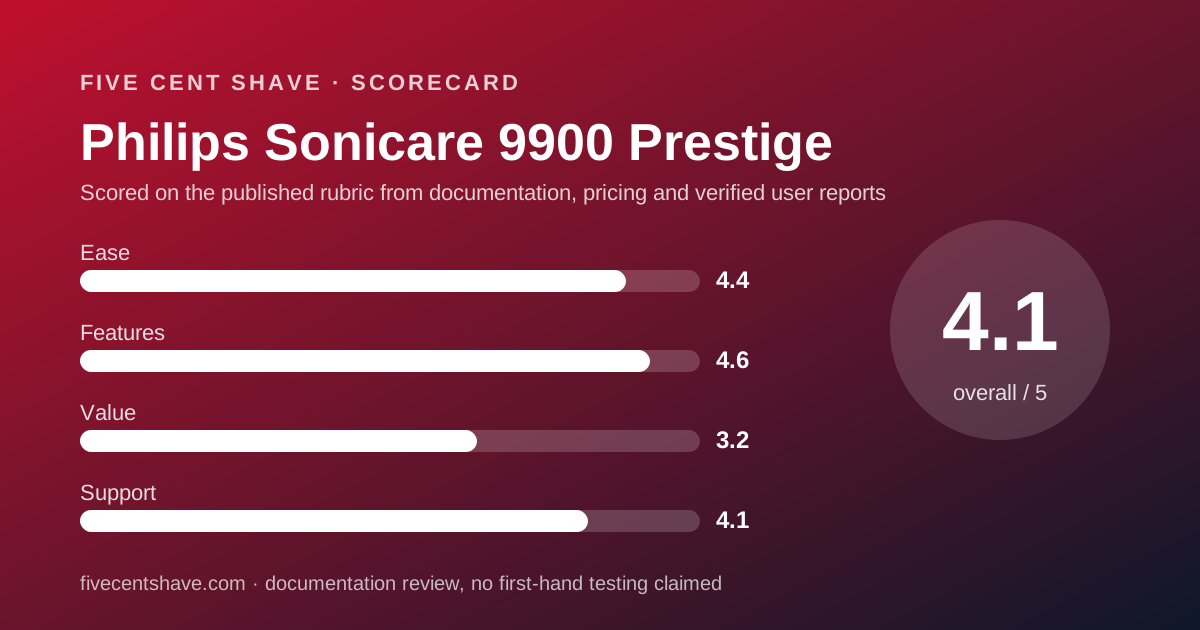
Ease of use: what the 4.4 is built from
The adaptive intensity does the hardest part of good brushing, easing off, without the user acting. The handle carries its own timer, pacer and pressure ring. Fifteen mode and intensity combinations are more than most people need, which is the main deduction.
The published 14-day battery and the USB case remove two common sources of friction: not knowing when to charge, and packing a proprietary charger.
Features: what the 4.6 is built from
Adaptive SenseIQ sensing, five modes, three intensities, BrushSync, a two-year software commitment and a USB charging case put the Prestige level with the iO9 on paper. It loses a tenth to the iO9 for shipping one head instead of four and for lacking the on-handle screen.
Documentation quality is better than Oral-B's: movements per minute, runtime and voltage are all stated.
Value: what the 3.2 is built from
Value is the lowest grade on this page and the lowest of the four brushes in our oral care set. $399.96 with one head, against $249.99 with four heads for the iO9 and $99.99 for the iO5, is hard to justify on features alone.
The score is not lower because the documentation, the software window and the two charging options are real, stated benefits that the cheaper handles lack.
Support and warranty: what the 4.1 is built from
Philips states a two-year limited warranty on the page header and in the specification data. The support page lists a user manual PDF (dated October 2021) and FAQ topics including charging on the base and in the travel case.
No money-back window is stated on the product page, which is why the grade sits a tenth below Oral-B's 4.2 despite the stronger software commitment. Waterpik's three-year warranty on the Aquarius remains the benchmark in this category.
What verified owners report
The Philips page renders reviews through Bazaarvoice, and the eight that rendered on October 16, 2026 were all marked Verified buyer. An aggregate rating and total count did not render in the readable page or its data, so this review does not quote one.
Across the visible reviews, four themes repeat: the app and its feedback are liked; the battery holds charge over long ownership; the clean feels thorough; and price is the recurring con, listed plainly as Price under cons by several owners.
Eight reviews are not a sample. They are consistent with the spec sheet (battery, app) and with the obvious weakness (price), which is why they are mentioned at all.
For owner data with a published count, the Oral-B iO5 page shows 4.5 out of 5 from 302 reviews and the Waterpik compare page shows 4.64 from 2,893. Philips' page is less transparent on that point.
Health claims and the ADA on this page
Philips' claims on the page: up to 20 times more plaque removal, 100 percent whiter teeth in two days, up to 15 times healthier gums in six weeks. The disclaimers read: vs. a manual toothbrush; in 6 weeks vs. a manual toothbrush; in less than 2 days vs. a manual toothbrush. No study is cited on the page.
The page does not mention the American Dental Association. The iO9 page shows an ADA Accepted image; the Prestige page shows nothing equivalent. Whether the model holds the Seal is a question for the ADA directory, not this page.
The ADA states that both manual and powered brushes remove plaque effectively, recommends two minutes twice a day with fluoride toothpaste, soft bristles, and head replacement every three to four months. None of this is medical advice; ask a dentist about your own case.
Alternatives
Choose the Oral-B iO Series 9 if you want seven modes, a color screen, four heads in the box and a $150 lower price, and you are fine with a warning-only pressure sensor and no published battery figure. Otherwise choose the Prestige if adaptive intensity and documented specs are worth the premium.
Choose the Oral-B iO Series 5 if you want the essentials, pressure sensor, timer and app, for $99.99. It carries the best owner rating of the three brushes on the vendors' own pages.
Choose a Waterpik Aquarius alongside any of them if your gaps are between the teeth. The ADA recommends daily interdental cleaning in addition to brushing; a water flosser is one option for that.
All four are graded in our oral care section by the same documentation method.
Bottom line
The Philips Sonicare 9900 Prestige is the premium brush with the best paperwork: 62,000 movements per minute, 14 days of battery, full box contents, a two-year software window and adaptive pressure control, all stated by Philips as of October 16, 2026.
It is also the worst value in our set at $399.96 with one head. Buy it if the adaptive SenseIQ behavior and the documented specs matter more than the $150 to $300 saved on an Oral-B iO. Otherwise the iO Series 5 is the rational pick.
This is a documentation review. No one here used the brush; every figure traces to the Philips page or the ADA.
Buy it if
- You want the brush to adjust itself. SenseIQ lowers intensity automatically under excess pressure, per Philips; the Oral-B sensor warns but does not adjust.
- You want numbers, not adjectives. Philips states 14 days of battery and 62,000 movements per minute; Oral-B states neither for the iO9.
- You travel internationally. The 110 to 220 V supply and USB charging case are stated on the spec sheet.
- You prefer sonic action. A side-to-side sweep at high frequency is a different feel from an oscillating round head.
Skip it if
- Price per feature matters. The Oral-B iO Series 5 delivers a pressure sensor, timer and app for a quarter of this price.
- You want several heads included. One A3 head is in the box; the iO9 bundle includes four.
- You want an ADA Seal shown on the product page. Philips' page does not display one for this model as of October 2026.
Frequently asked
How long does the Sonicare 9900 Prestige battery last?
Philips states 14 days operating time from full to empty on the US product page, checked October 16, 2026. The handle uses a lithium-ion battery with an illuminated icon for charge level. Both the charging base and the USB travel case charge it.
What is in the box with the Sonicare 9900 Prestige?
Per the product page: one DiamondClean Prestige 9900 handle, one A3 All-in-One brush head, one Prestige USB charging travel case and one charging base and stand. Additional A3 Premium heads (HX9092/95) are sold separately as a 2-pack.
What does SenseIQ actually do?
Philips says SenseIQ checks pressure, motion and coverage up to 100 times per second and automatically adjusts brushing intensity based on pressure and motion. Pressure feedback is a purple light ring plus vibration and a pulsing sound. The app adds coaching from the same data.
How much does the Philips Sonicare 9900 Prestige cost?
The product data on usa.philips.com listed $399.96 for HX9990/12, in stock, on October 16, 2026. The visible page did not display a price in the text we could read, so this figure comes from the page's embedded product data. Prices change; treat it as a dated snapshot.
Is the Sonicare 9900 Prestige ADA accepted?
The Philips US product page does not mention the American Dental Association or display a Seal as of October 16, 2026. That is a statement about the page, not the product. The ADA Seal directory is the place to confirm current acceptance for any model.
Sonicare 9900 Prestige or Oral-B iO Series 9?
Philips wins on documentation and adaptive intensity; Oral-B wins on price ($249.99 versus $399.96 on October 16, 2026), heads in the box (four versus one) and modes (seven versus five). Read the full comparison for the row-by-row table.
Sources
- Philips Sonicare 9900 Prestige HX9990/12 product page (specifications, box contents, warranty, embedded price data, verified-buyer reviews) - checked October 16, 2026
- Philips Sonicare 9900 Prestige support page (FAQ titles, user manual listing) - checked October 16, 2026
- ADA oral health topic: Toothbrushes - checked October 16, 2026
Update history
- October 16, 2026 - First documentation review. Specifications read from the usa.philips.com product page and its embedded specification data on October 16, 2026.
Visit Philips Sonicare 9900 Prestige
We have no affiliate relationship with this vendor. Link goes to the official site.