 Five Cent
Oral-B iO Series 9 vs Sonicare 9900 Prestige: which to buy
The Oral-B iO Series 9 is the better buy for most people: $249.99 with four heads, seven modes and a color screen against $399.96 with one head for the Philips Sonicare 9900 Prestige, per the two vendor pages on October 16, 2026. The Prestige wins on documentation and on sensing: Philips publishes a 14-day battery and 62,000 movements per minute, and SenseIQ lowers intensity automatically when you press too hard, where Oral-B only warns. This is a documentation review built from the two product pages, the warranty terms and the owner ratings each vendor publishes; nobody here used either brush.
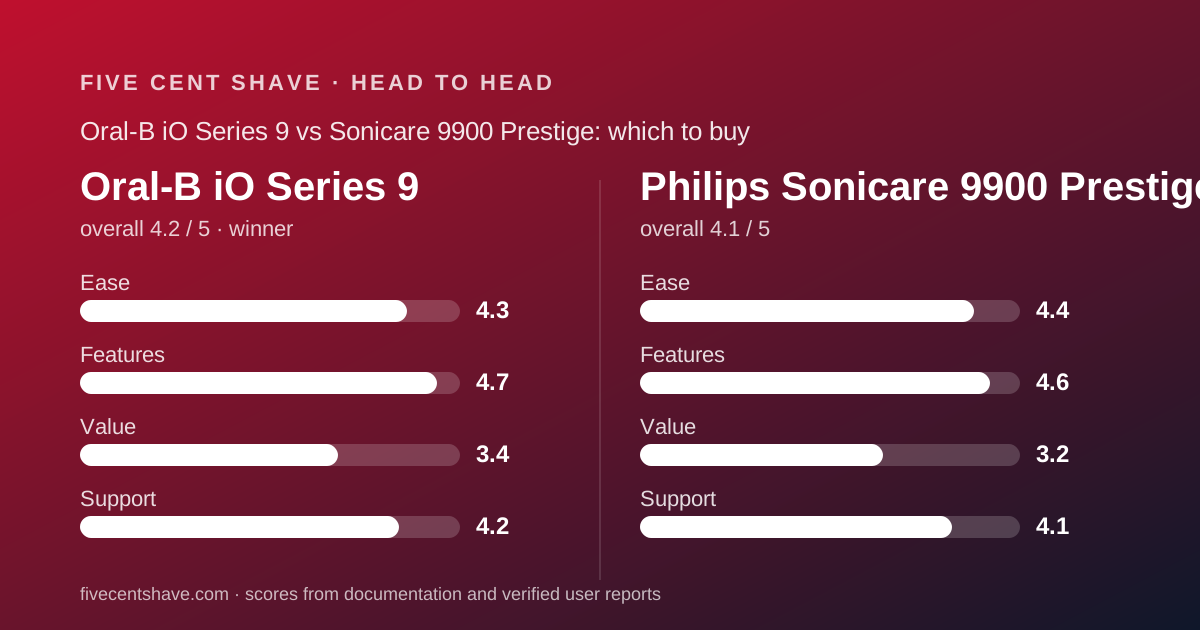
 4.2Oral-B iO Series 9
 4.1Philips Sonicare 9900 Prestige
Specification by specification
| Spec | Oral-B iO Series 9 | Philips Sonicare 9900 Prestige |
|---|---|---|
| Price on vendor page (Oct 16, 2026) | $249.99 (reference $329.99) | $399.96 (page product data) |
| Brushing motion | Oscillating-rotating round head with micro-vibrations | Sonic sweep, 62,000 brush movements per minute |
| Modes / intensities | 7 modes; intensity not separately stated | 5 modes x 3 intensities |
| Pressure sensing | Smart Pressure Sensor: too hard / too soft / just right (warns) | SenseIQ: pressure, motion, coverage up to 100x per second; auto-adjusts intensity |
| On-handle display | Interactive color display | Light ring and icons; no screen |
| Battery runtime | Not published | 14 days full to empty |
| Charge time | About 3 hours | Not published |
| Travel case | Power2Go charging case with cord | Prestige USB charging case |
| Heads in the box | 4 iO Ultimate Clean (bundle option) | 1 A3 Premium All-in-One |
| App | Oral-B App: AI recognition, 3D Teeth Tracking | Sonicare app: SenseIQ coaching, BrushSync, progress reports |
| Software support period | Not published | 2 years of updates after purchase |
| Warranty / returns | 2 years; 30-day money-back | 2-year limited; no return window stated |
| ADA Seal shown on page | ADA Accepted image in gallery | Not mentioned |
| Owner rating on vendor page | 3.9 / 5 from 328 reviews; 67% recommend | Verified-buyer reviews shown; aggregate not readable |
| Our scores (ease / features / value / support) | 4.3 / 4.7 / 3.4 / 4.2 | 4.4 / 4.6 / 3.2 / 4.1 |
The short answer
Two brushes, two philosophies, one clear price gap. Here is the split before the detail.
- Oral-B iO Series 9 is best for buyers who want the most hardware per dollar: seven modes, a color screen, four heads and a charging case for $249.99, plus a 30-day money-back window
- Philips Sonicare 9900 Prestige is best for buyers who want the brush to manage pressure for them and want every spec in writing: 14-day battery, 62,000 movements per minute, a two-year software commitment
- Winner for most people: the iO Series 9, on price, box contents and return terms
- Documentation caveat: every figure here comes from oralb.com and usa.philips.com on October 16, 2026 and from the ADA; no brush was used in preparing this page
Pricing: the iO9 costs $150 less and includes three more heads
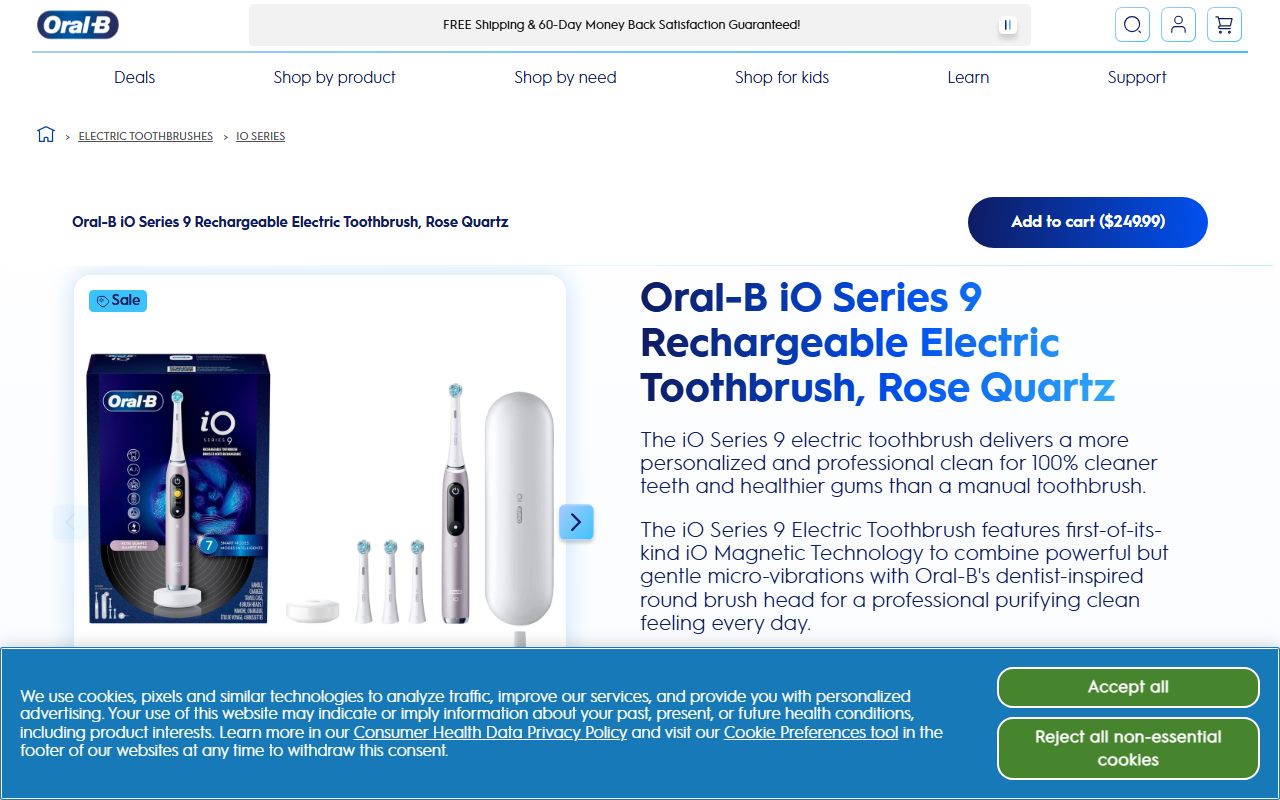
On October 16, 2026 the Oral-B US page listed the iO Series 9 at $249.99 against a $329.99 reference, with a Toothbrush + Brush Heads option that includes four iO Ultimate Clean heads. The Philips page's product data listed the 9900 Prestige at $399.96 with one A3 Premium All-in-One head.
That is a $150 gap on the handle and a further gap on refills: three extra heads in the Oral-B box cover roughly nine months at the ADA's three-to-four-month replacement interval. Editorial math, from vendor box contents and ADA guidance.
Oral-B also lists a 30-day money-back guarantee. Philips' product page states no return window. For a purchase in this price class, a stated 30-day exit is a real term, not a footnote.
Neither refill price was clearly labeled on the pages read, so this comparison does not quote refill costs. Both vendors sell heads in multi-packs; check the current listing. Full detail is in the Oral-B iO Series 9 review and the Sonicare 9900 Prestige review.
Pressure sensing: Philips adjusts, Oral-B warns
This is the most meaningful technical difference on the two spec sheets. Oral-B's Smart Pressure Sensor tells you whether you are brushing too hard, too soft or just right, and the color display shows the state. You then change what you are doing.
Philips' SenseIQ checks pressure, motion and coverage up to 100 times per second and, per the specification entry, automatically adjusts brushing based on pressure and motion. The feedback is a purple ring, vibration and a pulsing sound, but the motor has already eased off.
The ADA's reason to care is gingival abrasion: it recommends soft bristles to minimize that risk, and overbrushing is the behavior behind it. A brush that intervenes on its own addresses the behavior more directly than a light does.
Neither vendor publishes a clinical study on the page for its sensor's effect on gum outcomes. The difference above is a difference in stated mechanism, not in proven results.
Modes and motion: seven oscillating modes vs five sonic modes with three intensities
Oral-B lists seven modes on the iO9: Daily Clean, Whiten, Gum Care, Sensitive, Super Sensitive, Intense Clean and Tongue Clean. Philips lists five on the Prestige, Clean, White+, Deep Clean, Gum Health and Sensitive, with Low, Medium and High intensities across them.
Counted as combinations, Philips offers 15 and Oral-B seven. Counted as distinct purposes, Oral-B's Tongue Clean is the only mode with no Philips equivalent on these pages. Most people settle on one or two modes; the counts matter less than the sensing.
The motion is a genuine fork. The iO head oscillates and rotates with micro-vibrations; the Prestige sweeps at 62,000 movements per minute. Oral-B publishes no rate for the iO9. The ADA states both powered and manual brushes remove plaque effectively, and does not rank oscillating against sonic.
If you have used one style for years, the other will feel different for a week. That is preference, not a specification, and this page cannot settle it for you.
Battery and charging: Philips tells you, Oral-B does not
Philips states a 14-day operating time from full to empty, a lithium-ion cell, an illuminated battery icon and a 110 to 220 V power supply. Oral-B states a long-lasting lithium-ion battery and a low-charge indicator, and gives no runtime on the US page.
Oral-B does state what Philips omits: a full charge in about 3 hours on the magnetic charger. Philips gives no charge time. Each vendor leaves one blank; Philips' blank matters less, because a runtime is what you plan around.
Both ship charging travel cases. Oral-B's Power2Go case comes with a charging cord; Philips' Prestige case charges over USB. Both also include a counter charger. On travel hardware the two are even.
Verified buyers on the Philips page repeatedly describe the handle holding charge over years of ownership; that is owner report, not specification. Oral-B's page offers no comparable statements that could be read.
Display and app: Oral-B puts more on the handle, Philips commits to software longer
The iO9's Interactive Color Display shows mode, the two-minute timer and charge status without a phone. The Prestige uses a light ring and icons; feedback detail lives in the app. If you do not want to brush with a phone nearby, the Oral-B handle tells you more.
In the apps, Oral-B lists AI brushing recognition and 3D Teeth Tracking to guide coverage. Philips lists real-time SenseIQ coaching, personalized tips, progress reports, BrushPacer, SmartTimer and BrushSync head reminders. Neither publishes an accuracy figure for position or coverage detection.
One line separates them: Philips states it offers relevant software updates for two years after purchase. Oral-B publishes no support period on the iO9 page. For a connected device you intend to keep for years, a written window beats silence.
Both handles work fully without their apps. The timers, modes and pressure feedback are on the hardware.
Warranty, returns and the ADA Seal: Oral-B's terms are broader on paper
Both vendors state two-year warranties. Oral-B adds a 30-day money-back guarantee and describes an online repair tool with a prepaid label. Philips lists a user manual and FAQ topics on its support page and no return window on the product page.
On the ADA Seal, the iO9 gallery shows an ADA Accepted image; the Prestige page does not mention the American Dental Association. That is a statement about what each page displays. The ADA Seal directory is the place to confirm either model's current status.
What the Seal means, per the ADA: the Council on Scientific Affairs reviewed clinical and laboratory data and found the product safe and effective at removing plaque and reducing gingivitis, for a five-year term. For powered brushes that includes bench tests under ANSI/ADA Standard No. 120 and a clinical safety study.
For what a Seal and a pressure sensor do and do not prove, see our grading method. Neither is a ranking against the other brush.
What owners report: Oral-B publishes a weaker number, Philips publishes none that could be read
The oralb.com widget for the iO9, rendered fully on October 16, 2026, showed 3.9 out of 5 from 328 reviews: 202 five-star, 27 four, 23 three, 25 two and 51 one-star. 126 of 189 respondents (67 percent) would recommend it. Sub-ratings: Cleaning 4.1, Quality 3.8, Value 3.5.
The Philips page rendered eight verified-buyer reviews and no aggregate rating or count that could be read from the page or its data. Across those eight, owners praised the app and battery and named price as the con.
A 16 percent one-star share on the iO9 is a real signal and the reason its value score is not higher despite the price advantage. For contrast, the cheaper Oral-B iO Series 5 showed 4.5 from 302 reviews and 89 percent recommending on the same site, the same day.
Neither sample is quoted owner by owner here. Eight reviews are not a sample, and 328 is a count, not a verdict.
Health claims: both pages state multiples without citing a study
Oral-B says the iO9 removes 100 percent more plaque than a regular manual toothbrush and delivers 100 percent cleaner teeth and healthier gums than a manual brush. No footnote or study appears on the page read.
Philips says the A3 head removes up to 20 times more plaque, gives 100 percent whiter teeth in two days and up to 15 times healthier gums in six weeks. The disclaimers read versus a manual toothbrush, with no study named on the page.
Both sets of claims share a baseline, the manual brush, and neither compares the two powered brushes to each other. The ADA's position is that both powered and manual brushes clean effectively when used for two minutes twice a day with fluoride toothpaste.
If you have gum disease, implants or orthodontics, the right question for a dentist is which head and mode, not which multiple. None of this page is medical advice.
Heads and refills: both lock you into one ecosystem
Oral-B states the iO handle works only with iO replacement heads; older Oral-B heads do not fit. Philips lists easy click-on Sonicare heads for the Prestige. Whichever you buy, you buy that brand's refills for the life of the handle.
The box contents set the first-year cost. The iO9 bundle ships four iO Ultimate Clean heads; the Prestige ships one A3 Premium All-in-One, with refills sold as a 2-pack (HX9092/95). At the ADA's three-to-four-month interval, the Oral-B box covers about a year and the Philips box about a quarter. Editorial math from vendor box contents and ADA guidance.
Neither refill price was clearly labeled in the page data read on October 16, 2026, so no figure is quoted. Both vendors run refill reminders: Oral-B's Brush Head Tracker and Philips' BrushSync. Check the current 2-pack and 4-pack prices before deciding; over five years the refills can cost more than the handle.
Choose the Oral-B iO Series 9 if
The spec sheets make the iO9 the default for these buyers.
- You want the most in the box for the money: four heads, a charging case, a color screen and seven modes for $249.99
- You want a return window: 30 days money back, stated on the vendor page
- You want feedback on the handle, not on a phone: mode, timer and charge state on the display
- You want the ADA Accepted mark displayed: it appears in the iO9 gallery and not on the Prestige page
Choose the Philips Sonicare 9900 Prestige if
The Prestige earns the premium for these buyers.
- You want the brush to ease off for you: SenseIQ auto-adjusts intensity under excess pressure
- You want the numbers in writing: 14-day battery, 62,000 movements per minute, 110 to 220 V, box contents and a two-year software window
- You prefer sonic motion or already own Sonicare click-on heads
- You travel abroad with it: the 110 to 220 V supply and USB case are on the spec sheet
Where a water flosser fits in this decision
Neither brush cleans between teeth the way interdental tools do. The ADA recommends cleaning between teeth once a day with floss or another interdental cleaner, in addition to brushing.
If your dentist's note is about the gaps rather than the surfaces, the $150 saved by choosing the iO9 over the Prestige covers a Waterpik Aquarius at $99.99 MSRP with a three-year warranty and the ADA Seal stated on its page.
That combination, a mid-priced sensing brush plus an irrigator, follows the ADA's two-step guidance more closely than a single $400 handle does. Our oral care section grades all of these by the same method.
Bottom line
The Oral-B iO Series 9 wins this comparison on the documents: $150 less, three more heads, a color screen, a 30-day return and an ADA Accepted mark on the page, as of October 16, 2026. Its weaknesses are a missing battery figure and a 3.9 owner rating with a 16 percent one-star share.
The Philips Sonicare 9900 Prestige is the better-specified and better-documented brush, and the only one of the two that adjusts pressure on its own. It costs $399.96 with one head, and Philips publishes no return window and no readable owner aggregate.
Buy the iO9 unless adaptive pressure control or Philips' written specifications are worth $150 to you. Either way, read the two full reviews and check the ADA directory before you pay. This is a documentation review; no brush was used.
Frequently asked
Which is cheaper, the Oral-B iO Series 9 or the Sonicare 9900 Prestige?
The iO Series 9 at $249.99 (reference $329.99) on oralb.com, versus $399.96 in the Philips page's product data, both on October 16, 2026. The Oral-B bundle also includes four heads to the Prestige's one.
Which has the better pressure sensor?
On stated mechanism, Philips. SenseIQ senses pressure, motion and coverage up to 100 times per second and automatically lowers intensity. Oral-B's Smart Pressure Sensor signals too hard, too soft or just right but leaves the adjustment to you. Neither vendor cites a clinical outcome study for its sensor on the page.
Which battery lasts longer, iO9 or Sonicare Prestige?
Only Philips publishes a figure: 14 days from full to empty. Oral-B states a long-lasting lithium-ion battery and about 3 hours to full charge, with no runtime, as of October 16, 2026. A comparison cannot be made from the vendor pages.
Can I use Sonicare heads on an Oral-B iO, or iO heads on a Sonicare?
No. Oral-B states the iO handle works only with iO replacement heads, and Philips lists easy click-on Sonicare heads for the Prestige. Switching brands means switching refill ecosystems; factor the refill price into the decision.
Is either brush ADA accepted?
The iO9 product gallery shows an ADA Accepted image; the Prestige page does not mention the ADA as of October 16, 2026. The ADA Seal is awarded for five years after a Council on Scientific Affairs review. Confirm current status for either model on the ADA Seal directory.
Visit Oral-B iO Series 9
We have no affiliate relationship with this vendor. Link goes to the official site.
Visit Philips Sonicare 9900 Prestige
We have no affiliate relationship with this vendor. Link goes to the official site.