 Five Cent
What the ADA Seal and a pressure sensor actually tell you
Two badges appear on almost every premium toothbrush page: an ADA Seal and a pressure sensor. Both are worth having. Neither means what the marketing copy around it implies. The Seal is a safety and efficacy review with a five-year term, not a ranking. A pressure sensor is a warning light on most brushes and an automatic adjustment on a few. This note explains what each one does and does not prove, using the ADA's published criteria and the product pages for the brushes graded on this site, all read on October 16, 2026. It is not medical advice.
The ADA Seal is a pass/fail review, not a league table
The American Dental Association describes its Seal of Acceptance as a mark of safety and efficacy for oral care products, awarded by the ADA Council on Scientific Affairs. A submission must include data from clinical and/or laboratory studies showing the product meets the requirements for its category.
Two details matter for a buyer. The Seal is awarded for a five-year period, after which the company must reapply, and the ADA states plainly that not every product submitted qualifies. The ADA's public page does not say whether companies pay to apply; that question was left open when read.
What the Seal does not do is compare products. Two brushes can both hold the Seal; the Seal tells you nothing about which cleans better. The ADA's own toothbrush topic page states that both manual and powered brushes are effective at removing plaque.
What a powered toothbrush must show to earn the Seal
For powered brushes, the ADA lists specific requirements on its toothbrush topic page. The Seal indicates the brush is safe and efficacious for the removal of plaque and the reduction of gingivitis.
- Bench tests based on ANSI/ADA Standard No. 120 for electrical safety, tuft retention, mechanical strength and chemical resistance
- A clinical study showing the brush is safe for hard and soft oral tissues and for dental restorations
- Compliance with a safety laboratory such as Underwriters Laboratories
- Review of the manufacturer's data by the Council on Scientific Affairs before the Seal is granted
Read that list again: it is about not harming you and about removing plaque. It is not about whitening, about app accuracy or about one motion being superior to another.
A product page showing the Seal is not the same as the ADA directory
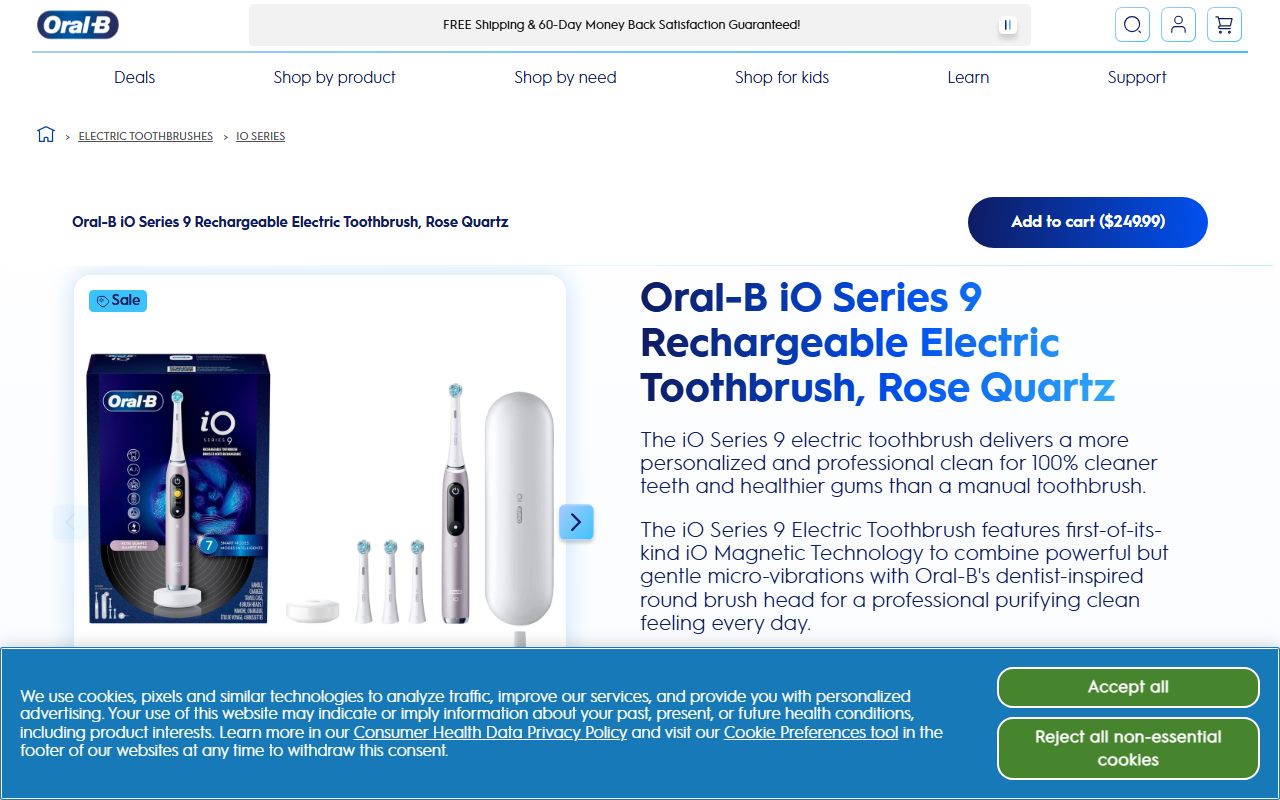
Among the brushes graded here, the Oral-B iO Series 9 page shows an image labeled ADA Accepted in its gallery. The Oral-B iO Series 5 page and the Philips Sonicare 9900 Prestige page do not mention the ADA at all.
That tells you what each page displays, not what each product holds. A Seal can be current, lapsed or never applied for, and a product page will not say which. The ADA's Seal directory is the only place to confirm status for a specific model, and it is worth the two minutes before a $250 to $400 purchase.
The Waterpik Aquarius page goes further than any brush page: it states the device is accepted by the ADA for safety and effectiveness and reproduces the Seal's wording about plaque along the gumline and gingivitis. For oral irrigators, the ADA's criteria require evidence that the device plus brushing beats brushing alone.
A pressure sensor tells you about your hand, not about the brush's cleaning
The ADA recommends soft bristles because they minimize the risk of gingival abrasion. Overbrushing is the behavior that causes that abrasion. A pressure sensor exists to interrupt the behavior.
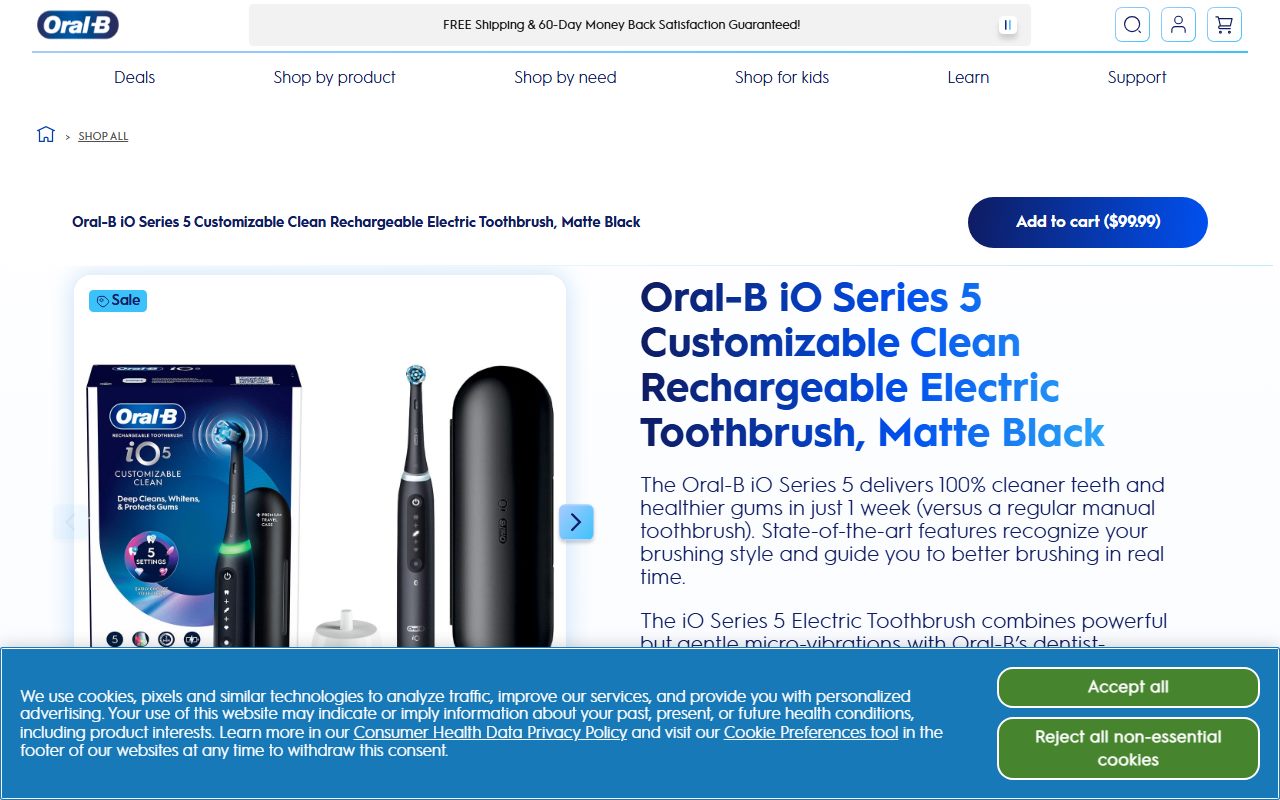
On the two Oral-B handles, the Smart Pressure Sensor signals too hard, too soft or just right. On the iO9 that state appears on the color display; the iO5 page does not say exactly how it is shown. In both cases the correction is yours to make.
On the Sonicare 9900 Prestige, SenseIQ senses pressure, motion and coverage up to 100 times per second and, per the specification entry, automatically adjusts brushing based on pressure and motion. The ring turns purple and the handle pulses, but the motor has already eased off.
That is the useful distinction when reading a spec sheet: warns, or warns and adjusts. Neither vendor publishes a clinical study on its page showing the sensor changes gum outcomes. The mechanism is documented; the result is not.
Neither badge speaks to the claims printed next to it
Oral-B's pages say the iO removes 100 percent more plaque than a regular manual toothbrush. Philips says the A3 head removes up to 20 times more plaque and gives 15 times healthier gums in six weeks. Both sets of claims are footnoted, where they are footnoted at all, as versus a manual toothbrush, with no study named on the page.
The Seal does not certify those multiples. The pressure sensor has nothing to do with them. A buyer who sees a Seal, a sensor and a 20x claim on one page is looking at three unrelated things, only two of which the vendor has to substantiate to anyone.
Waterpik is the exception in this set: its claims name studies (Barnes 2005, Sharma 2008, a 2014 Tufts study) and label the 99.9 percent plaque bacteria figure as a laboratory study on file. That is how a claim should be footnoted.
How to read a toothbrush page in sixty seconds
- Find the Seal. If it is shown, note it; confirm the model on the ADA directory before you rely on it
- Find the sensor line. Ask: does it warn, or does it adjust? Philips adjusts; Oral-B warns, with three states
- Find the battery line. Philips states 14 days; Oral-B states no runtime for the iO5 or iO9 as of October 16, 2026
- Count heads in the box and note the ADA's three-to-four-month replacement interval
- Find the warranty and return terms: two years on all three brushes, 30 days money back only on Oral-B's pages
- Find the owner rating with its count: 4.5 from 302 (iO5), 3.9 from 328 (iO9), none readable (Prestige)
- Treat every multiple (100 percent, 20x, 15x) as unverified unless a study is named
Bottom line
The ADA Seal means a brush passed a safety and plaque-removal review for five years. A pressure sensor means the brush can tell when you press too hard, and on a few models it does something about it. Both are reasons to prefer a brush; neither is a reason to pay more for one brush over another that also has them.
Pick by what the page actually documents: sensor behavior, battery figure, box contents, warranty, owner count. Our best electric toothbrushes guide applies exactly that reading to the Oral-B iO Series 5, the iO Series 9 and the Sonicare 9900 Prestige, and the iO Series 9 vs Sonicare 9900 Prestige comparison puts the two premium handles side by side.
If you have gum recession, implants, braces or periodontal pockets, the badge that matters is a dentist's recommendation for your mouth. Nothing here replaces that.
Sources
- ADA Seal of Acceptance program overview (Council on Scientific Affairs, five-year term, evidence requirement) - checked October 16, 2026
- ADA oral health topic: Toothbrushes (powered vs manual, soft bristles, Seal requirements for powered brushes, ANSI/ADA Standard No. 120) - checked October 16, 2026
- ADA oral health topic: Floss and interdental cleaners (oral irrigator Seal criteria, Cochrane 2019) - checked October 16, 2026
- Oral-B iO Series 9 product page (ADA Accepted image, Smart Pressure Sensor) - checked October 16, 2026
- Philips Sonicare 9900 Prestige product page (SenseIQ specification entries) - checked October 16, 2026
- Waterpik Aquarius WP-660 product page (ADA acceptance statement, cited studies) - checked October 16, 2026