 Five Cent
Waterpik Cordless Advanced 2.0 vs Philips Flosser 3000
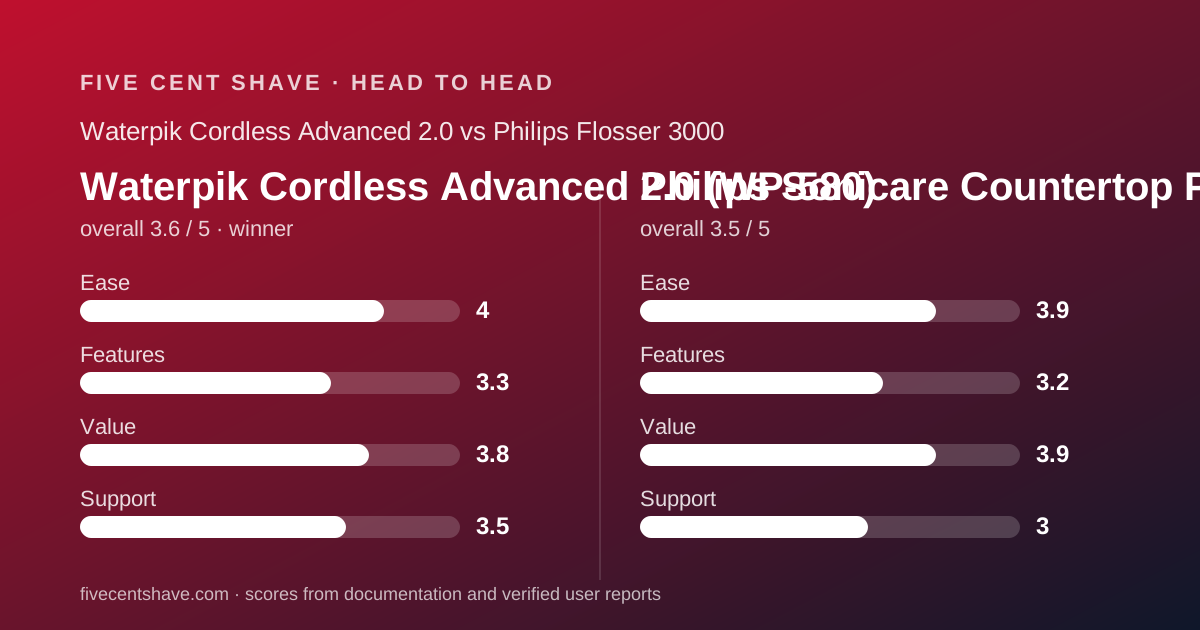
Short answer: the Waterpik Cordless Advanced 2.0 is the narrow winner, because Waterpik publishes figures you can check and the ADA publishes a Seal Statement you can read. But the money and the tank both favour Philips: $89.96 and 550 ml against $99.99 and 207 ml, both read on October 30, 2026. If the flosser will sit on a counter and never move, the Philips Sonicare Countertop Power Flosser 3000 is the better buy. If it has to travel or go in the shower, only the Waterpik can do it.
 3.6Waterpik Cordless Advanced 2.0 (WP-580)
 3.5Philips Sonicare Countertop Power Flosser 3000 (HX3711/20)
Specification by specification
| Spec | Waterpik Cordless Advanced 2.0 (WP-580) | Philips Sonicare Countertop Power Flosser 3000 (HX3711/20) | Difference |
|---|---|---|---|
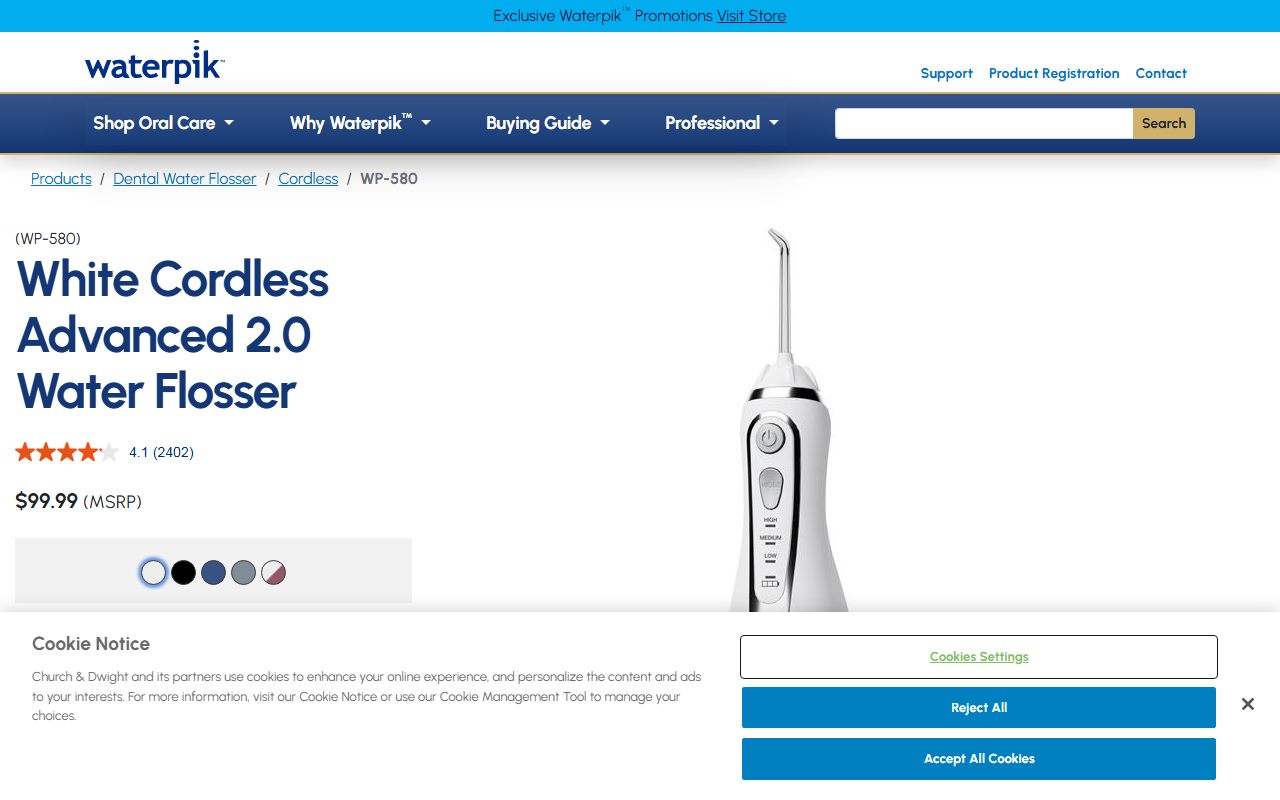
| List price | $99.99 MSRP, waterpik.com | $89.96, usa.philips.com | Philips is $10.03 cheaper |
| Form | Cordless handheld, battery | Corded countertop, base and hose | Different jobs |
| Reservoir or tank | 7 oz (207 ml), rated 45 seconds | 550 ml, rated 90-plus seconds | Philips holds about 2.7x more |
| Pressure settings | 3 | 10 | Philips, by seven steps |
| PSI range | Not published by Waterpik on the page or in the manual | Not published by Philips in its specification data | Neither vendor publishes it |
| Pulses per minute | 1,250 | Not published | Only Waterpik publishes it |
| Flow rate | 10 oz (296 ml) per minute | Not published | Only Waterpik publishes it |
| Modes | 1 (pressure only, no massage mode) | 2 (Clean, Deep Clean) | Philips |
| Tips or nozzles in the box | 4: 2 Precision, 1 Orthodontic, 1 Plaque Seeker | 2: F1 Standard, F3 Quad Stream | Waterpik, and with braces and implant tips |
| Replacement consumable price | Tips sold separately; Waterpik prices them on its store, not the product page | $14.96 per two-nozzle pack, priced on the product page | Philips is the clearer figure |
| Timer or pacer | None listed | Pacer pauses every 30 seconds | Philips |
| Shower use | Yes, marked waterproof and shower-safe | No, mains-powered countertop unit | Waterpik only |
| Size and weight | 11.60 x 2.80 x 4.00 in; 0.80 lb | Not published by Philips | Only Waterpik publishes it |
| Power | Lithium-ion, 4.86 Wh, up to 4 weeks per charge; USB-A 5 V DC 1 A | Mains, multi-voltage charger, no voltage range published | Waterpik is more specific |
| Warranty | 24-month limited; excludes tips and batteries | 2-year limited; no exclusion list published | Same length, Waterpik states the terms |
| ADA Seal | ADA publishes a Seal Statement for Waterpik Cordless Water Flossers | Not mentioned on the Philips page; ADA listing unreadable on October 30, 2026 | Waterpik, verifiable at the ADA |
| Owner rating on the vendor page | 4.1 from 2,402 reviews | 4.0 from 53 reviews, 87% recommend | Close, but Philips has a thin sample |
The short answer
Two water flossers at nearly the same money, built on opposite ideas. Waterpik puts the pump in your hand and accepts a small tank; Philips keeps a large tank on the counter and accepts that it never moves.
- The Waterpik Cordless Advanced 2.0 is best for a shower, a suitcase or a bathroom with no counter space, and for anyone who wants braces and implant tips in the box.
- The Philips Sonicare Countertop Power Flosser 3000 is best for a fixed bathroom, a 90-second session without refilling, ten pressure steps and the cheapest published nozzle cost.
- Our winner is the Waterpik, on the narrow ground that its figures and its ADA Seal Statement can both be checked by a reader. It is not the better value.
- Full reviews: Waterpik Cordless Advanced 2.0 and Philips Countertop Power Flosser 3000, both graded October 30, 2026.
Neither vendor publishes a PSI figure, so neither can claim more pressure
Start here, because it decides how much the rest of the comparison is worth.
We read Waterpik's WP-580 product page and its full instruction manual on October 30, 2026 and found no pressure figure in either. The manual discusses pressure only as settings you turn up or down.
We read Philips' HX3711/20 product page and the specification data Philips publishes for that model on the same day and found ten pressure settings listed and no PSI range.
So any article telling you one of these units hits a specific PSI did not get it from the maker. Three settings against ten tells you about granularity, not about force.
What Waterpik does publish and Philips does not: 1,250 pulses per minute and a 10 oz (296 ml) per minute flow rate. Two numbers with no counterpart is still the better documentation.
Philips wins the tank by a factor of about 2.7
This is the clearest win on either side. Waterpik rates the WP-580 reservoir at 7 oz (207 ml) and 45 seconds of flossing. Philips rates its tank at 550 ml and a 90-plus second clean.
By our arithmetic, that is roughly 2.7 times the water. In practice it is the difference between finishing a pass and stopping to refill.
The cordless design is why. A handheld unit has to carry its own water, and 207 ml of water is already most of the 0.80 lb the WP-580 weighs empty.
Philips also documents what the extra water buys: a 60-second complete clean in Clean mode and a 90-second guided pass in Deep Clean mode.
If refilling mid-session is the thing that would make you give up on water flossing, the decision is made here and the rest of this page is detail.
Waterpik wins the box, and specifically the tips
Waterpik's accessory table lists four tips in the WP-580 box: two JT-450E Precision tips, one OD-100E Orthodontic tip for braces and one PS-100E Plaque Seeker tip for implants, crowns, bridges and veneers.
Philips ships two nozzles, an F1 Standard and an F3 Quad Stream, and its specification data states the unit fits only F1, F2 and F3.
That restriction matters for a specific group of buyers. If you wear braces or have an implant, Waterpik sells a tip designed for your case and Philips does not.
Philips does mark a Great for implants and braces row Yes for the HX3711/20, but that is a claim about what the Quad Stream nozzle can do, not a dedicated tip.
Waterpik also includes a microfiber travel bag and a travel water plug. Philips includes a power adapter.
Philips wins the running cost, and prints it where you can see it
Philips lists the F2 Comfort and F3 Quad Stream nozzle packs at $14.96 each on the product page itself, two tips per pack, and its specification data says to replace nozzles every six months.
Our arithmetic, not Philips': about $15 a year for one user, about $30 for two.
Waterpik's cleaning guidance on the WP-580 page says to replace tips every 3 to 6 months, but prices its tips on its separate store rather than on the product page, so the yearly figure is not available from the page we graded.
That is a documentation gap rather than a price problem. Still, a buyer comparing total cost can finish the sum for the Philips and not for the Waterpik.
Neither unit has a consumable beyond tips, since one is corded and the other has a sealed non-replaceable battery.
The warranties are the same length, and only one is written down
Waterpik gives 24 months on the WP-580 and Philips gives a 2-year limited warranty on the HX3711/20. On length, a draw.
On substance, not a draw. Waterpik publishes the full warranty text in the manual that ships with the unit: two years from purchase, original receipt required, the whole product returnable on request, and tips and batteries excluded.
The same manual also states plainly that Water Pik, Inc. does not guarantee the availability of replacement parts, repair services or information needed to maintain its flossers. That is unflattering and useful.
Philips' published specification data for this model contains the phrase 2-year limited warranty and no exclusion list, no claims process and no returns window that we could read on October 30, 2026.
A buyer who wants to know what is excluded before paying can find out for the Waterpik and cannot for the Philips.
The ADA Seal is checkable for one of these and not the other
This is a health product, so this section matters more than the specification table.
Waterpik's page states that the Cordless Advanced 2.0 is accepted by the American Dental Association for safety and effectiveness. We checked that against the ADA's own site.
The ADA's product listing titled Waterpik Cordless Water Flossers carries a Seal Statement saying the Council on Scientific Affairs found the product safe and effective for removing plaque along the gumline and between teeth, and for helping prevent or reduce gingivitis, when used as directed.
For Philips, two things are true and neither is a verdict. The product page does not mention the ADA Seal anywhere.
And the ADA's own listing for the brand's power flosser could not be opened on October 30, 2026, because the link redirected in a loop.
We are not saying Philips lacks a Seal. We are saying we could not read it on the day, and that Philips does not claim it on the page we graded.
Our note on what the ADA Seal and a pressure sensor tell you sets out why that distinction matters.
Both sets of clinical claims are narrower than they first read
Each vendor makes outcome claims, and each footnotes them. The footnotes are the honest part.
Waterpik says the WP-580 removes up to 99.9 percent of plaque bacteria from treated areas, footnoted as a laboratory study, data on file. Treated areas means where the water hit.
It also claims up to 2X the effect of string floss on plaque and gum health, and up to 3X around braces with the Orthodontic tip.
Philips claims up to 180 percent more effective than floss for gum health, footnoted as after two weeks, against string floss, with the Quad Stream nozzle.
Its 99 percent below-the-gumline claim is footnoted as a lab study in pockets up to 6 mm, and its 99.9 percent claim as an in-vitro study.
So one vendor's headline rests on a two-week clinical result and the other's on unpublished data on file. Neither is a reason to choose between them.
Owner ratings are close, but the samples are not comparable
Waterpik's page showed 4.1 out of 5 from 2,402 reviews for the WP-580 on October 30, 2026. Philips showed 4.0 out of 5 from 53 reviews for the HX3711/20, with 87 percent of reviewers recommending it.
A tenth of a point apart, on samples that differ by a factor of 45. We weight the Waterpik figure more heavily and treat the Philips figure as early.
For context from the same day: Waterpik showed 4.6 from 2,905 reviews for the countertop Waterpik Aquarius and 4.6 from 983 reviews for the Sonic-Fusion 2.0 Professional.
That makes the WP-580 the lowest-rated Waterpik flosser we have graded, which is worth saying out loud in a page that names it the winner.
We report vendor aggregates only and do not quote individual reviews, because we cannot verify which configuration each reviewer bought.
The Waterpik has a sealed battery; the Philips has no battery at all
This is the longevity argument, and it runs the opposite way to the portability one.
Waterpik's WP-580 manual states that the battery of this product is not replaceable, and warns that disassembling the unit voids warranty service. The specification table rates the lithium-ion cell at 4.86 watt hours.
So the working life of the Waterpik is the working life of one sealed cell, and the 24-month warranty excludes batteries by name.
The Philips is mains-powered, so there is no cell to degrade. Its failure modes are the pump, the hose and the seals, and Philips sells nozzles rather than internals.
Neither vendor publishes an expected service life, and we will not invent one. What we can say from the documents is that one unit has a consumable power source and the other does not.
Waterpik does disclose, in the same manual, that it does not guarantee the availability of replacement parts or repair services. Philips publishes no equivalent statement either way in the data we read.
Neither of these replaces cleaning between your teeth every day
Both vendors sell water flossing as a step up from string floss. The ADA's own position is narrower than that, and it applies equally to both machines.
The ADA's interdental cleaning page recommends brushing twice a day and cleaning between teeth with floss or another interdental cleaner once a day, and names water flossers among those cleaners.
It also cites a 2019 Cochrane review of home interdental devices. That review found evidence for oral irrigators limited and inconsistent, with most outcomes measured over one to three months and the overall evidence graded low to very low certainty.
The same page notes that interdental brushes may be more effective than floss, and that the right choice depends on the patient: tight spaces suit floss, open spaces and periodontitis may suit brushes.
So the honest framing for either unit is that it is one way to do a daily job, chosen partly because people stick with it. We do not give dental advice; ask your dentist or hygienist which cleaner suits your mouth.
Also compared
Two other units belong in this decision, and both are countertop machines.
The Waterpik Aquarius listed at $99.99 MSRP on waterpik.com on October 30, 2026, marked InStock, with ten pressure settings, a 22 oz (651 ml) reservoir, 1,400 pulses per minute, seven tips and a 36-month warranty.
It also carries a one-minute timer with a 30-second pacer. On documented specification it beats both units on this page.
Waterpik's Sonic-Fusion 2.0 Professional listed at $199.99 on the same site and day. It puts the water jet through a sonic brush head, which removes the separate tip library entirely.
Philips' own Power Flosser 7000, model HX3911/30, was marked Discontinued on usa.philips.com on October 30, 2026, with 4.7 from 106 reviews and four flossing modes. We exclude discontinued models from recommendations.
If the real gap in your routine is brushing rather than flossing, our best electric toothbrushes guide is the better place to spend $90.
The Oral-B iO Series 5 sits near this price with a pressure sensor, and the Philips Sonicare 9900 Prestige sets the ceiling.
Choose the Waterpik if, choose the Philips if
Both are competent. The decision is about where the thing lives and what you need from the paperwork.
- Choose the Waterpik Cordless Advanced 2.0 if you want to floss in the shower, which is the one thing the Philips cannot do.
- Choose the Waterpik if you wear braces or have implants, because the Orthodontic and Plaque Seeker tips come in the box.
- Choose the Waterpik if you want a checkable ADA Seal Statement and published pulse and flow figures.
- Choose the Waterpik if your bathroom has no spare counter space or no free outlet near the sink.
- Choose the Philips Power Flosser 3000 if the unit will live on a counter and you want a 550 ml tank rather than 207 ml.
- Choose the Philips if you want ten pressure steps and a 30-second pacer for $89.96.
- Choose the Philips if you want to know the consumable cost before you buy, at $14.96 for two nozzles.
- Choose the Philips if you are testing whether you will stick with water flossing at all, since it is the cheaper entry.
Bottom line
On our rubric the Waterpik Cordless Advanced 2.0 scores 3.65 and the Philips Sonicare Countertop Power Flosser 3000 scores 3.50. That is close, and the gap is documentation rather than hardware.
The Waterpik wins because a reader can verify what it claims: pulse rate, flow rate, dimensions, warranty exclusions and an ADA Seal Statement on the ADA's own site.
The Philips wins on the two numbers most buyers actually feel: $89.96 and 550 ml. For a flosser that will sit on a counter and never move, that is the better purchase.
If neither constraint is binding, read our Waterpik Aquarius review first. At $99.99 it documents ten settings, 651 ml, seven tips and 36 months of warranty, and on paper it beats both units here.
All figures were read from waterpik.com, usa.philips.com and ada.org on October 30, 2026, and will be rechecked. Neither unit was operated for this comparison.
Frequently asked
Which is cheaper, the Waterpik Cordless Advanced 2.0 or the Philips Power Flosser 3000?
The Philips, by $10.03. Philips listed the HX3711/20 at $89.96 on usa.philips.com and Waterpik listed the WP-580 at $99.99 MSRP on waterpik.com, both read October 30, 2026. Philips also prices its replacement nozzles at $14.96 per two-pack on the same page.
Which has more pressure settings?
The Philips, with ten against three. Neither vendor publishes a PSI range, so the settings cannot be converted into pressure numbers. Waterpik does publish 1,250 pulses per minute and a 10 oz per minute flow rate; Philips publishes neither figure for this model.
Can either of these be used in the shower?
Only the Waterpik. Its specification table carries a May be Used in the Shower row marked Yes and the page describes the unit as waterproof. The Philips is a mains-powered countertop unit with a base and hose, and Philips makes no shower claim for it.
Which is better for braces or implants?
The Waterpik, on tips. The WP-580 box includes an OD-100E Orthodontic tip and a PS-100E Plaque Seeker tip. Philips fits only F1, F2 and F3 nozzles and has no tip specified for either case, although it marks a Great for implants and braces row Yes.
Which one has the ADA Seal of Acceptance?
Waterpik's claim is checkable. The ADA's own listing for Waterpik Cordless Water Flossers carries a Seal Statement, read October 30, 2026. The Philips page does not mention the Seal, and the ADA listing for the brand's power flosser redirected in a loop that day, so we could not confirm it.
Can I switch from one brand to the other and keep my tips?
No. Philips states the unit fits only F1, F2 and F3 nozzles, and Waterpik lists its own JT-450E, OD-100E and PS-100E tips for the WP-580 and WP-560 series. The two tip systems are not interchangeable.
Sources
- Waterpik product page and specification table, Cordless Advanced 2.0 WP-580 - checked October 30, 2026
- Waterpik WP-580 instruction manual (charging, warranty terms, parts availability disclosure) - checked October 30, 2026
- Philips product page, Sonicare Countertop Power Flosser 3000 HX3711/20 (price, availability, nozzle prices, owner rating) - checked October 30, 2026
- Philips published specification and disclaimer data for HX3711/20 - checked October 30, 2026
- ADA Seal of Acceptance product listing, Waterpik Cordless Water Flossers - checked October 30, 2026
- ADA oral health topic, Dental Floss and Interdental Cleaners (2019 Cochrane review on oral irrigators) - checked October 30, 2026
Visit Waterpik Cordless Advanced 2.0 (WP-580)
We have no affiliate relationship with this vendor. Link goes to the official site.
Visit Philips Sonicare Countertop Power Flosser 3000 (HX3711/20)
We have no affiliate relationship with this vendor. Link goes to the official site.